I started this assignment wanting to make a snowflake. Specifically, lots of little generative snowflakes connected into something that could fold and unfold. So naturally, I ended up with a vase.
As I experimented, I became more interested in making something that looked soft and almost like it was moving. I wanted folds, waves and a slightly unpredictable shape. How could I make a solid printed object feel less stiff? And could I do that through a few repeating rules instead of modelling every fold myself?
The final design is a very wavy vase. Its sides move in and out at different heights, and the ridges curve around the surface. It’s still recognisable as a familiar object, but the shape feels a little strange, which I liked.
p5.js sketch: https://editor.p5js.org/mariam4882/full/XdUTpTnpx
Shape
For my last assignment, I was making flat patterns that would become the sides of a box. This time, I had to think about the whole form, including what was happening between the parts I could see.
I built the shape in p5.js using rings of points stacked along its height. Each ring has 120 points around it, and the code calculates how far each point should be from the centre. Changing those distances changes the shape.
I liked being able to adjust the height, width, waves and ridges from the top of the sketch. I didn’t have to rebuild everything whenever I wanted to try something slightly different.
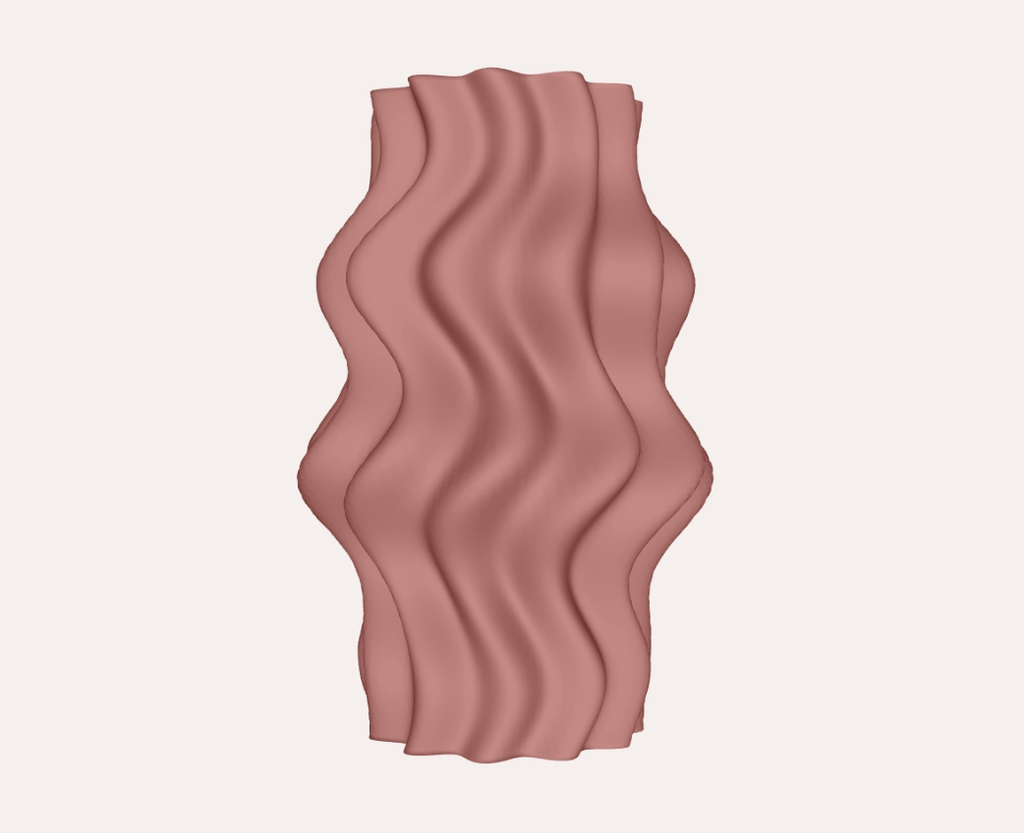
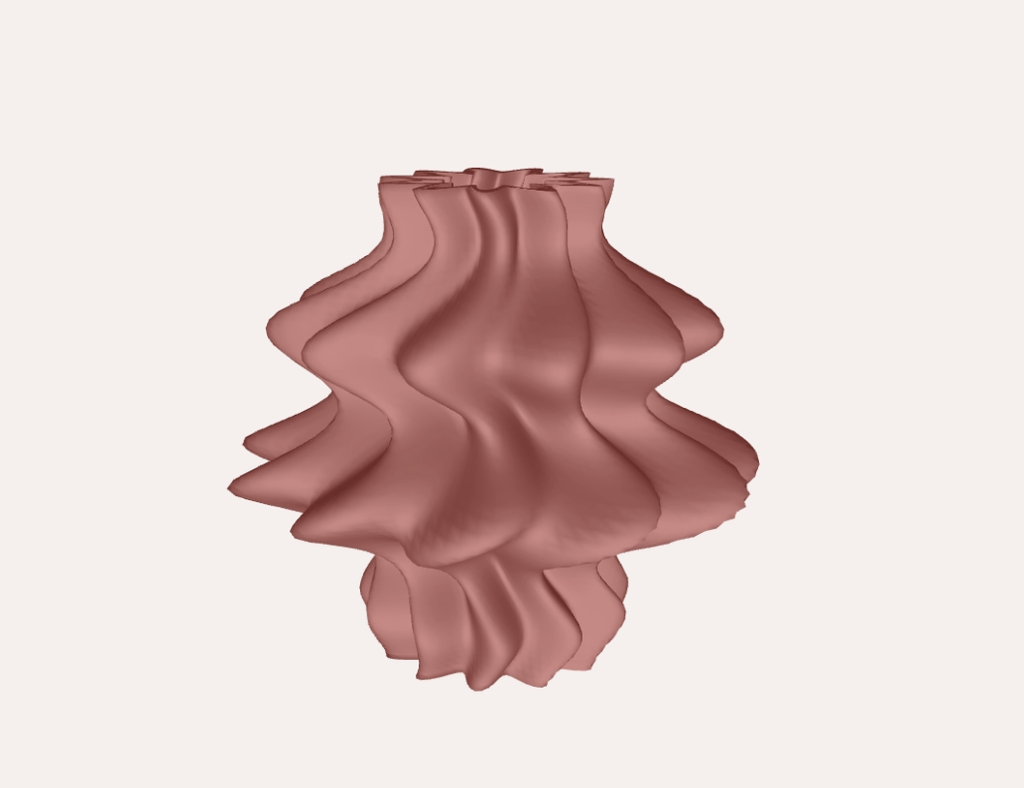
Getting the points into the right places was one part. Connecting them into something printable was another.
The code connects neighbouring points with triangles to make the surface. It creates an outer surface and a smaller inner one, with a 3 mm difference in radius between them, then connects the surfaces around the top and bottom edges.
I was initially paying much more attention to the outside. Did I like the silhouette? Were the folds interesting enough? But something can look like a complete object on screen without actually having all the parts it needs.
For example, the bottom connection in this version is a ring, rather than a solid floor. So despite calling it a vase, it’s currently more of a hollow sculptural vessel. A closed base would be the next thing to add if I wanted it to work as a functional vase.
I also added a button to export the geometry as an OBJ file so I could move it out of p5.js and prepare it for printing.
A lot of adjusting things
One of the harder parts was getting a shape I actually liked. Some of the earlier versions felt too symmetrical. I wanted something with a bit more movement, but I kept getting something that looked like a fairly regular vase. Where was the intrigue??
So I kept adjusting how the waves and ridges worked together. The outline moves in and out, while the ridges shift around it. Even though both follow repeating rules, combining them makes different parts of the object behave differently.
I was trying to find a balance where the shape still felt connected, but wasn’t completely predictable from one side to the other. I didn’t want to add variation just for the sake of it either. Sometimes changing more values made it harder to understand what was actually improving the form.
Then there was the inside. I had to think about the walls and how the surfaces joined, even though those were much less exciting to look at than the folds.
Seeing it off the screen
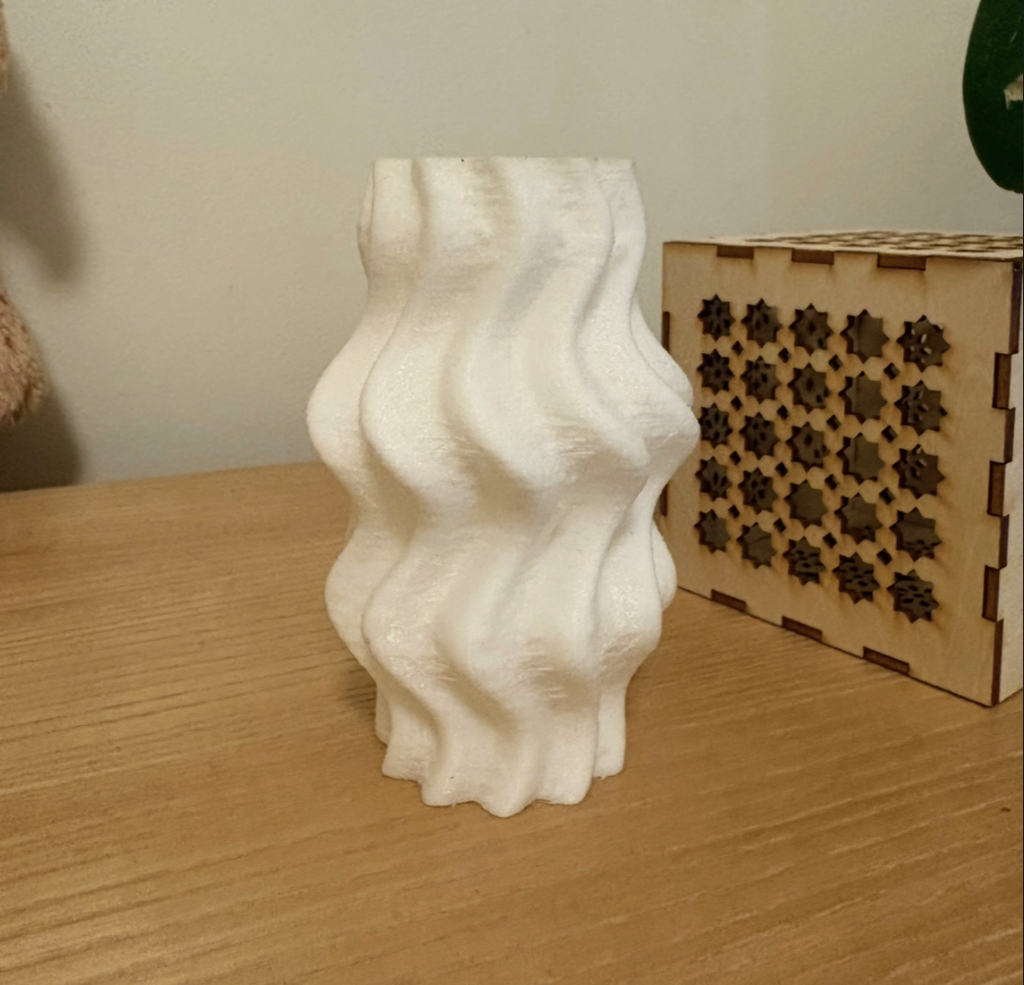
I really like how the white print catches the light. In p5.js, I needed the lighting to help me understand the shape. With the physical object, the folds create their own highlights and shadows, and different parts become more noticeable as I turn it.
The fine horizontal print lines are visible too. They run across the larger waves and ridges, so there’s this smaller texture sitting on top of the overall form. Something I was mostly thinking about as a smooth digital surface now has evidence of how it was made.
It sits beside the lamp from my previous assignment now, which is quite cute. Apparently, I am slowly making things for my room.
Looking back
I also liked seeing how much could come from a few rules. I didn’t draw each fold individually. Changing one value could affect the whole object, which made experimenting quite easy.
Next, I’d like to close the base and try making the form more uneven. Could some areas have much stronger waves while others stay quieter? How far could I push that before it became difficult to print? I think there’s still room to make it feel less like a regular vase without losing the parts I like.
And I do still want to make the folding snowflake. I just took a fairly large detour first hahaha.
I think it’s quite cool how your original idea was themed around a snowflake because I think I can kinda imagine how it naturally came to be this vase design
P.S. I’ve also acquired many decorations for my room from my weekly assignments haha