a. Concept
At first, I wanted to use the strings of my backpack, attaching crayons to them in order to draw on sheets of paper placed on the floor. However, this felt too manual and did not fully achieve the effect I was looking for. After thinking about the materials I had available, I eventually arrived at the idea of creating a drawing machine that relies on speed and gravitational force to produce its drawings.
As you can see in the video, this is a very simple system consisting of one tube, a sheet of paper placed on top of a plate, which is held in place on one side by a clothespin, and additional sheets of paper surrounding part of the plate to prevent trails from being left on the surface. Two bottles filled with liquid, in this case, two bottles of Axion, are used to hold the tube in place. Finally, a marker is used to create the drawing trails.
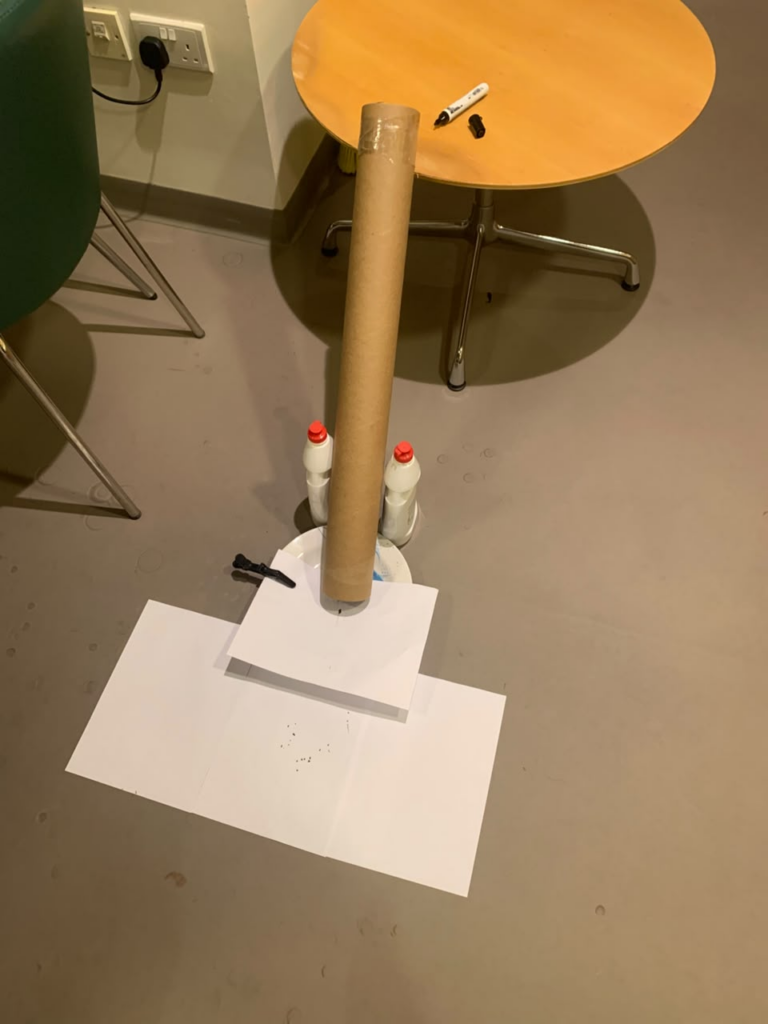
The way it works is very simple. The user only has to take a marker of their choice and place it at the top opening of the tube, allowing it to fall and leave a trail on the paper. This process can be repeated for as long as the user likes, allowing them to create different drawings and patterns.
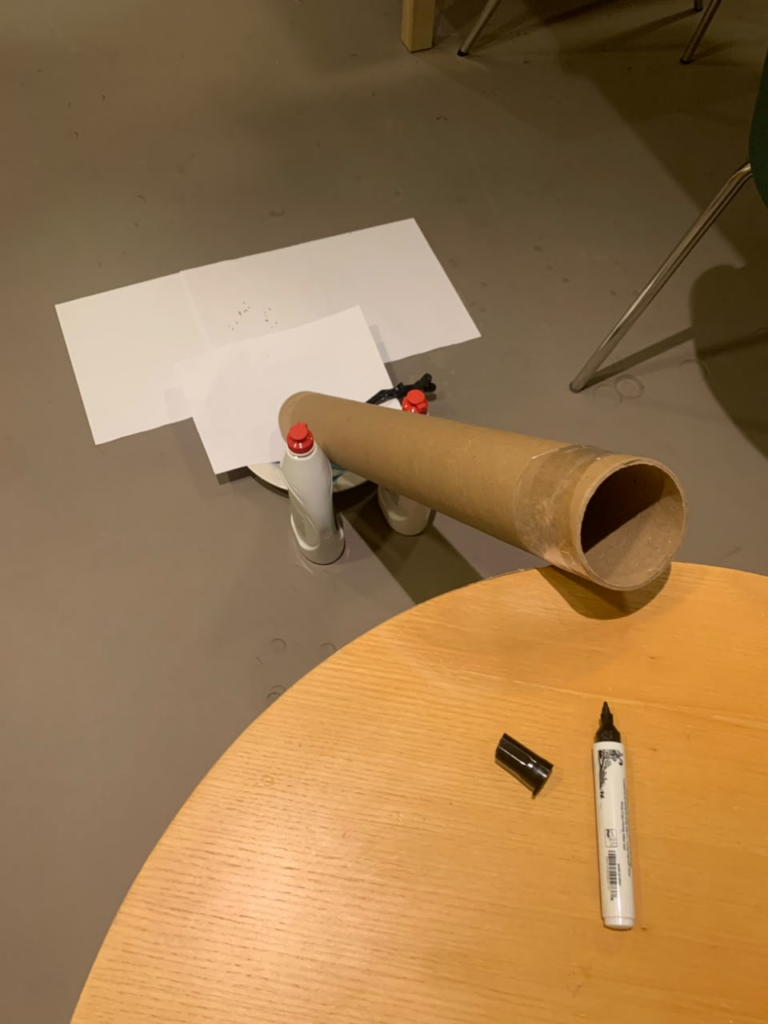
I admit that this can come across as a rather manual device. However, the lack of available objects that could automate the drawing process led me to rely on another kind of force instead: gravity. In the end, this simple system was able to produce some interesting results, as can be seen below.
b. Drawing outputs
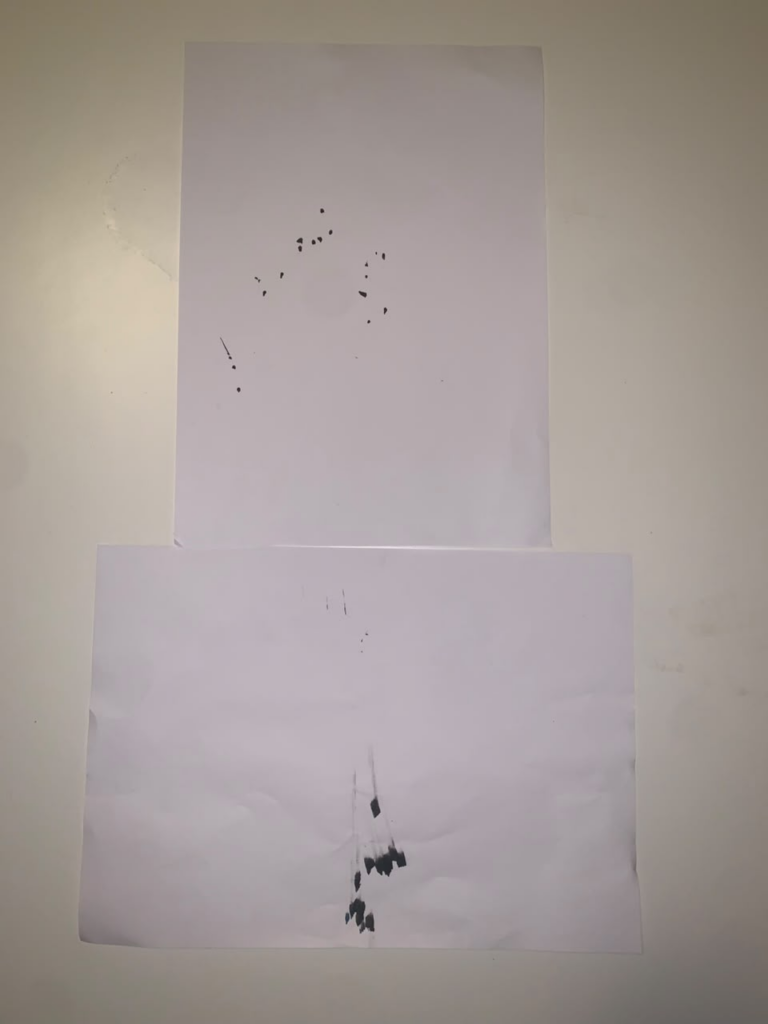
The result from the video.
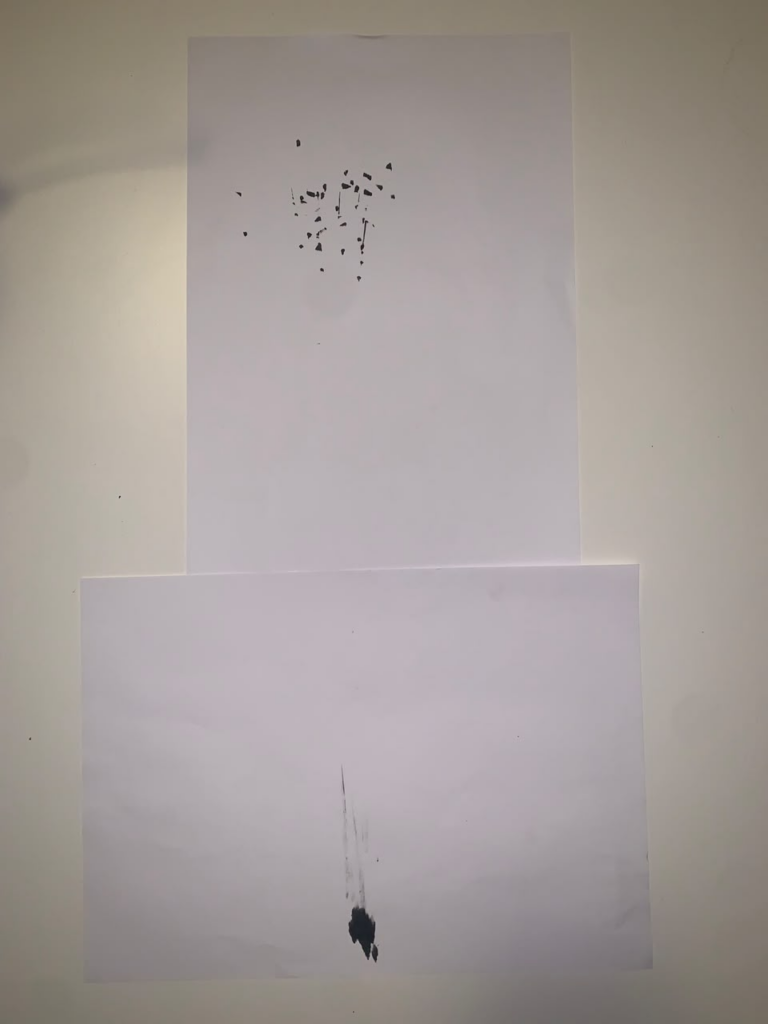
After recording the video, I did another one.
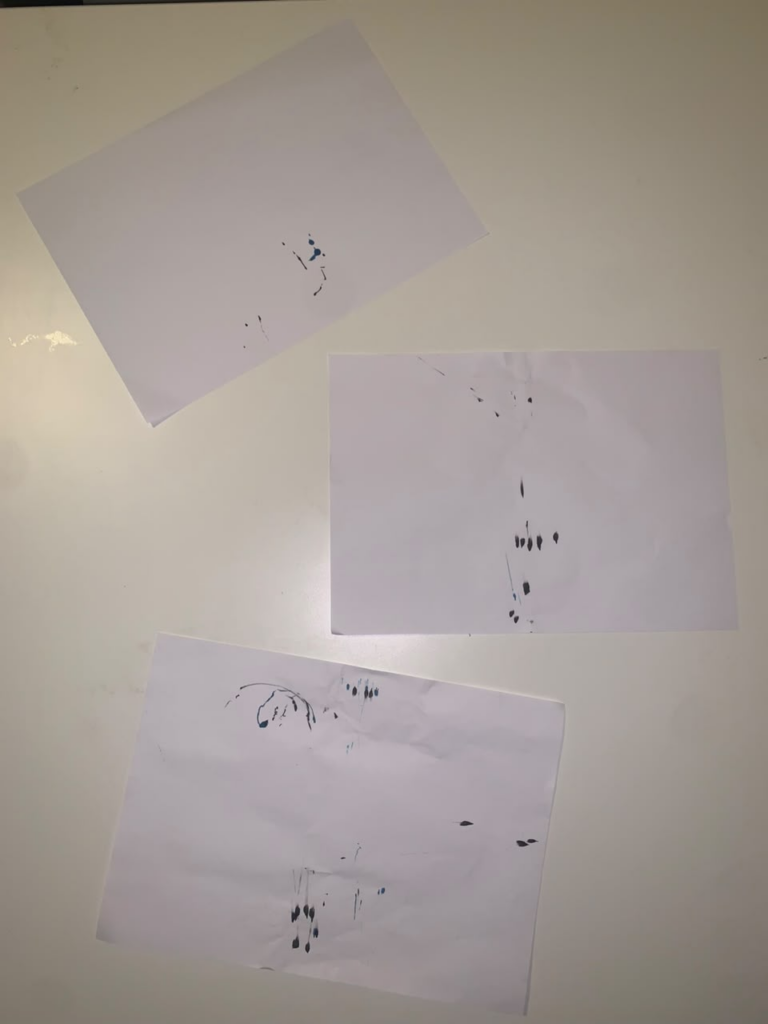
Other results from the machine. These are rather difference due to the fact that I moved the location of the clothespin to the top of the plate, making the markers leave a trail to the sides due to the collision.
c. Process and challenges
The process of making this machine is quite simple. The main idea was to find the necessary materials and arrange them as shown in the video. However, conceptually, I found this to be the hardest step. I tried to come up with more interesting ideas, but unfortunately, this was the only plausible one I could think of that could be made with the materials I had available, as well as those of my roommate.
Another challenge that I am not sure I was able to overcome was the machine’s reliance on a human element to produce the drawings. While the person is mostly acting as an activation force rather than actively drawing on the machine, there was no other reasonable solution I could think of that would completely remove the need for human interaction. Although this aspect was not entirely satisfactory from my perspective, I still expect the machine to provide some enjoyment through its physicality and the way the user interacts with it.
d. Reflection on control, chance, and authorship
When it comes to control in art, I do not believe that it is inherently a bad thing. Rather, it is simply a different way of approaching the creative process and influencing what the final result can be. Something similar can be said about chance in art. However, I would not want a machine or system to randomly create something without any clear purpose or intention, as I feel that the result could become meaningless.
When I mention something being “meaningless,” I am referring to the possibility of creating something with absolutely no idea or intention behind it. However, I believe this is not really possible. For example, if someone were to build a machine with the intention of having no purpose, then, in a strange way, the purpose of that machine would be to demonstrate that it has no purpose. It is a somewhat strange idea, but when looking at it more literally, I believe that authorship is not necessarily affected by either the level of control over the parameters of an artwork or the presence of chance and randomness.
This is because artworks generated through parameters are still, inherently, the result of human ideas. The person creating the system is envisioning some kind of final product, even if the final result may differ from what they originally had in mind. The parameters, materials, rules, and limitations are all decisions made by the artist, and these decisions shape the possibilities of what the system can produce.
For example, the system I created for this assignment was constructed through a series of improvised ideas using materials that I happened to encounter, some of them almost entirely by chance. Even though the final drawings are technically “made” by the machine, the results still reflect the decisions and ideas that I had throughout the process. I chose the materials, constructed the system, determined how it would work, and decided how the user would interact with it. The machine may have created the individual drawings for me, but the conditions that allowed those drawings to exist were created by me.
e. Where does the “idea” of your drawing reside?
For me, the idea resides in the design decisions rather than in the machine itself or the final drawing. There was certainly some deliberation involved in deciding to create something physical that is capable of creating drawings. However, the main purpose behind creating it was not simply to prove the existence of the machine. Rather, a demonstration of an idea: a way to produce art through the use of gravity, using whatever means were available to me.
To reiterate, I believe that the idea resides in the design decisions behind the system. These decisions included the idea of creating something that uses a different kind of medium to produce art, as well as determining the materials, structure, and way in which the machine would operate. The final drawing is simply the visible result of those decisions and of an idea that already existed in my mind. And although the machine is responsible for physically producing the drawing, it is still operating within a system that I conceptually imagined, idealized, and designed. It just happens that the idea of the drawing could, in theory, be observed in maximum detail when the design decisions are examined; similar to understanding what is happening inside the “black box.”