Concept
For this assignment, I focused on expanding upon what was taught in class regarding the drawing of patterns based on the divisions of tiles according to the screen width and height. Instead of always preparing a pattern from the same image of a silly cat, this time I used a random image pulled from a website.
That is why it is called “Pattern from the Internet.” A pattern that is randomly generated according to a specified algorithm in which is always (not in an infinite way of course) random.
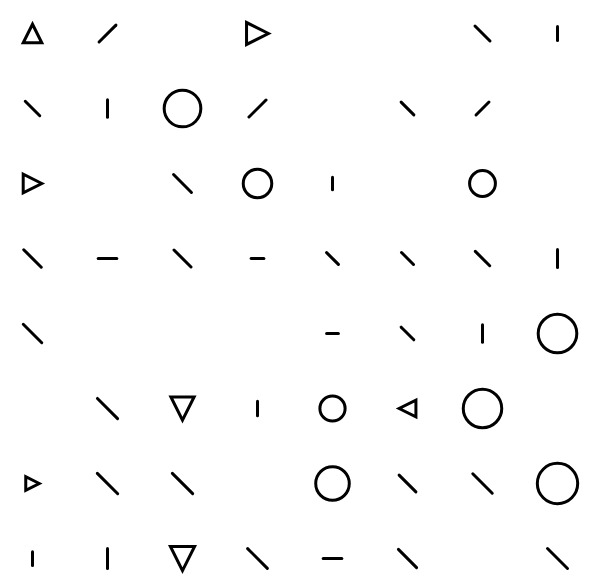
What image was this? Is it possible to decipher what it was before the algorithm?
p5.js sketch and code
The code was too large to explain, so here are the link to the sketch with the code (most of it commented), and also the basics of how it works:
Link to the sketch: https://editor.p5js.org/mdh8552/sketches/Pp1gYr6gV
Note: I tried embedding the sketch, but for some reason, the embedding it is not working.
- First, an image is preloaded from https://picsum.photos/, with a random ID generated by the program.
- After it is preloaded, the p5.js sketch is then prepared by dividing the screen into tiles, as taught in class on Wednesday.
- After it is divided, we enter the for loop for the 2D arrays.
- In this 2D array, according to the tile, the image from the internet is first analyzed to determine how big the geometrical figure will be.
- After determining how big it will be, we use a random chance to determine if it will be drawn on the tile. This is a 1 in 5 chance.
- If it is determined that the tile can be drawn, another random number from 0 to 4 is generated.
- According to the number generated, a random geometric figure will be drawn.
- This process is repeated until the for loop ends.
Vector design
The two vector designs that I got to print are the following:
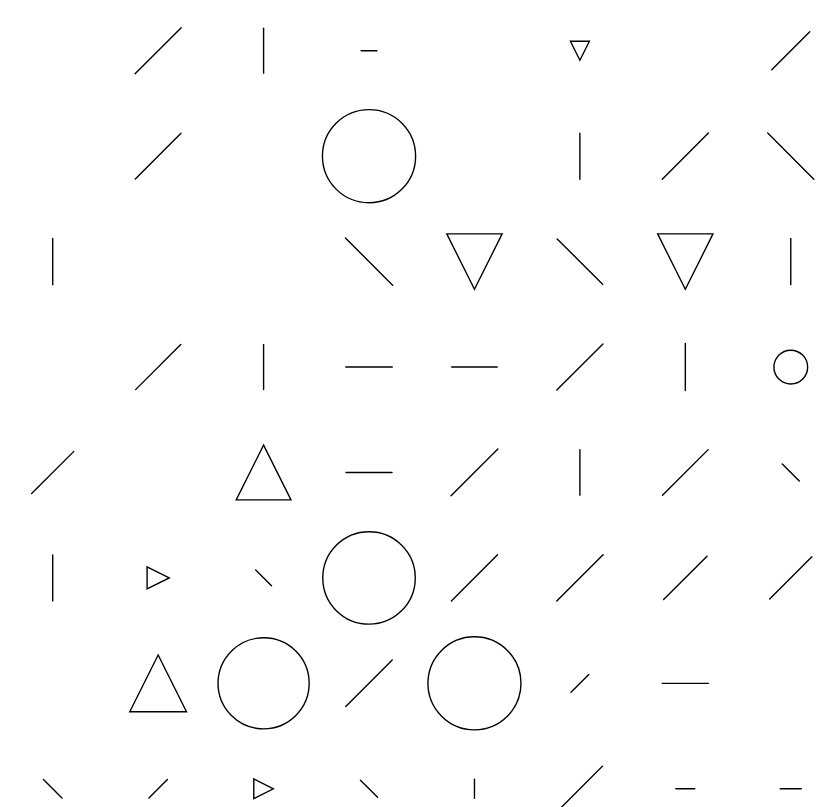
svg_from_the_internet_1.svg
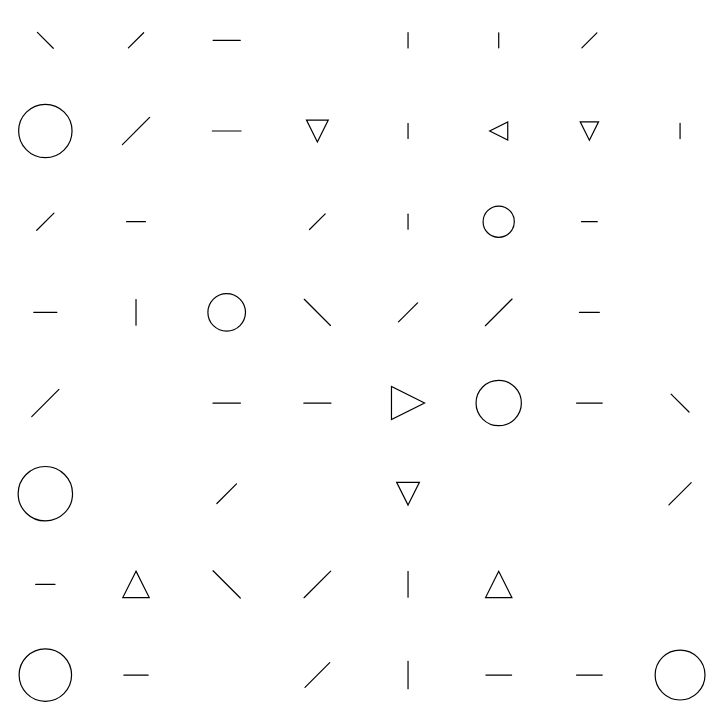
svg_from_the_internet_2.svg
I mainly designed this in a way that would not cause any trouble during the laser-cutting process. In previous classes, I encountered issues where my pattern was way too complex, and it would end up ruining the base. So, in order to avoid that, I went with this minimalistic approach.
Final fabricated result
The laser cut process itself was very straightforward, and there are the two results I got from it. Each one made out of different materials with a different pattern.
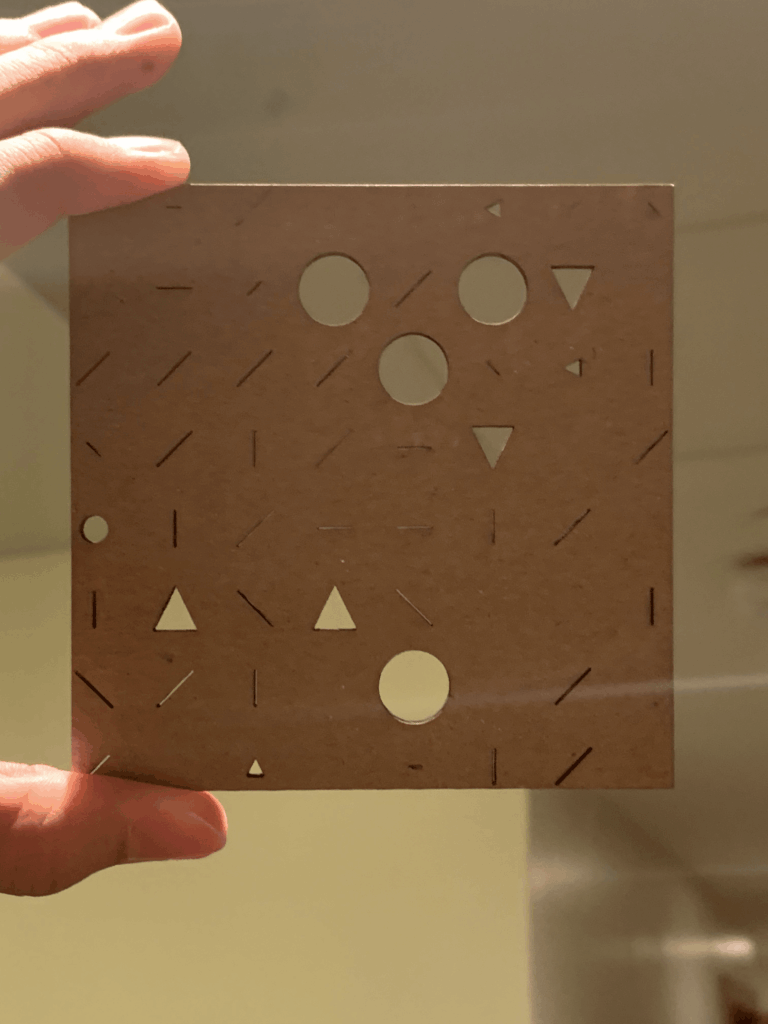
Pattern from svg_from_the_internet_1.svg, made with plywood.
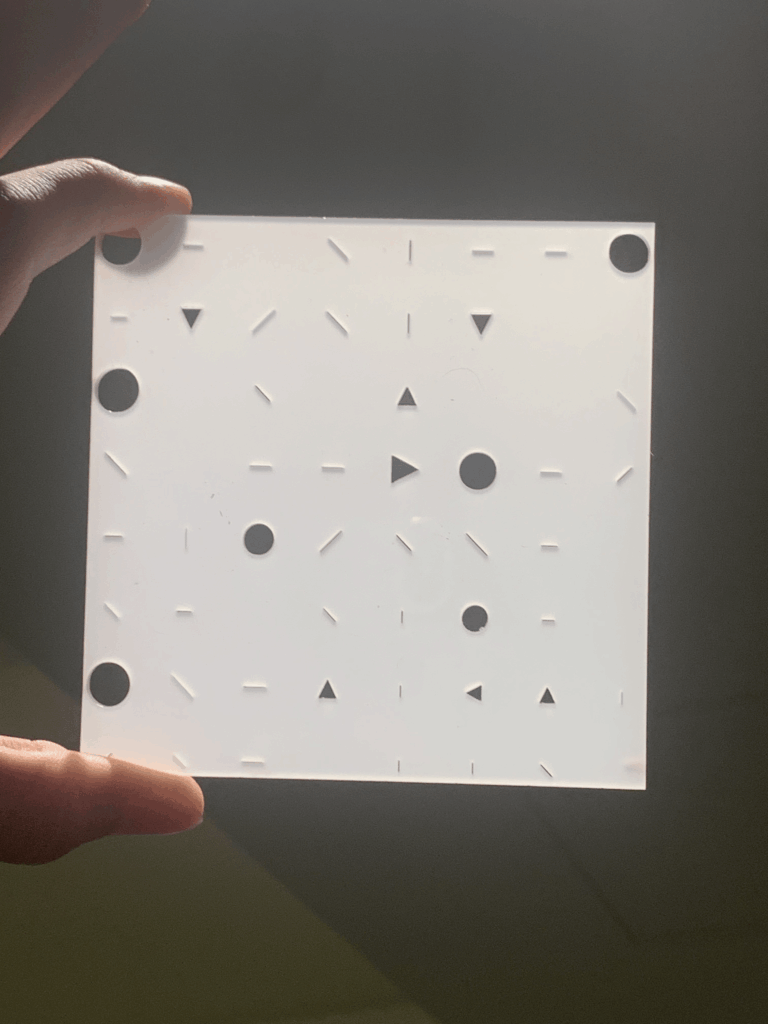
Pattern from svg_from_the_internet_2.svg, made with acrylic
Process and challenges
The process itself was very straightforward
The biggest challenge I encountered was conceptual. I found myself getting stuck on some ideas. While I would have loved to try new ideas or new concepts for this assignment, I felt that leaving the code we developed during class would be a bad idea. After all, there could be many implementations with the tile and image system. However, when I thought about the laser-cutting process, I had to limit myself to very simple shapes that I knew the machine could laser cut without any issues. That is why I took the approach of using geometric figures. They were simple, easy to laser cut, and would not give me as much trouble as some of my previous designs did.
Although, indeed, I believe that conceptually there could have been more to the project aside from just random figures with random chances.
Technically, there were no problems. I tried to expand more on some ideas I had, but technically, I would enter the realm of cheating if I just tried them, as I did not have a clear idea of how to implement some of these ideas. In other words, I did not want to purely rely on generative AI for them.
Reflection on how laser fabrication changed or shaped your computational design.
While it did not greatly change my perspective on computational design, as I had already done this before, it helped me remember how making a design for laser cutting has to be thoughtful. Your design cannot be too chaotic, since the laser cutting machine will probably just tear the material. Instead, you have to think about your design under certain restrictions in order to achieve the best output.
It is a collaboration between humans and machines that I find quite interesting. You can only work within the parameters and limitations set by the machine, and therefore, your designs will probably reflect some of these limitations. This is not to say that the designs will never be complicated, no. They just require more thinking outside the box. After all, what I consider to be genius are things that are made under certain restrictions.