My concept comes from the motion of doing simple things daily. I tried to get inspiration from mechanical things we utilize everyday and after a session of brainstorming I got up from my chair and opened my door. But there it was, that motion of holding the door handle and pushing it down inspired me to trace the arch that forms from moving this handle. So I attached a pen to the handle and tried to trace that motion
I unfortunately do not have paper and couldn’t get access to it as there aren’t bookstores near the area I live in (I live off campus) even though I could swear I had a note book somewhere. I will figure this out on Monday as I buy a notebook from the bookstore for this purpose.
Revision after getting paper:
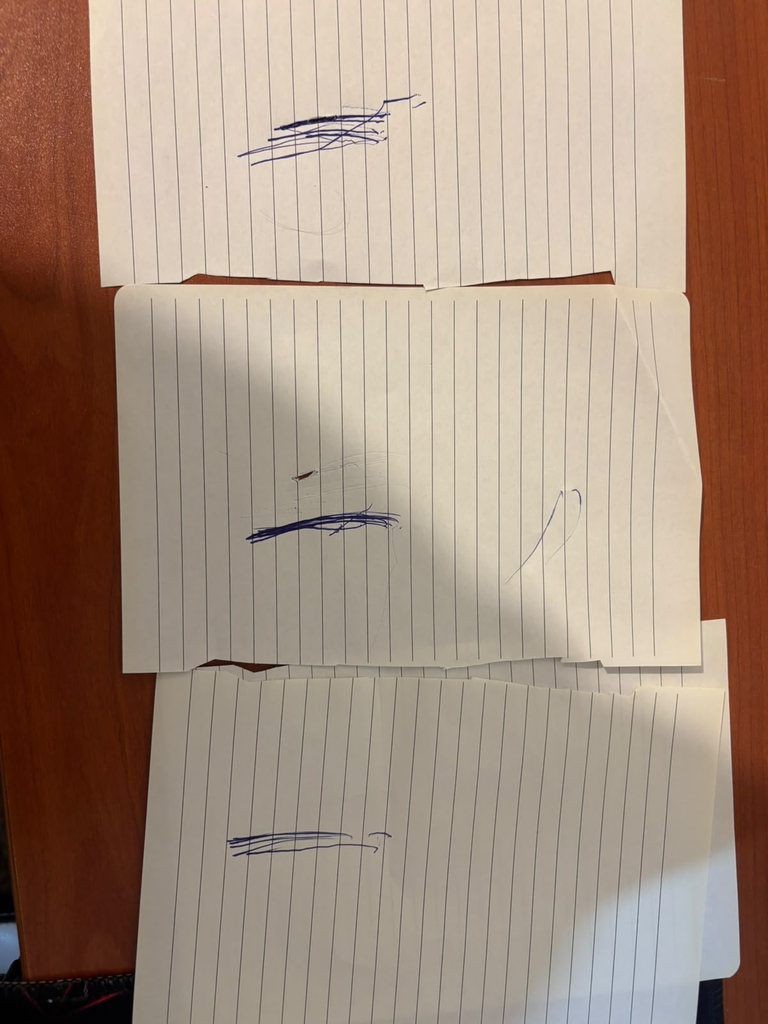
These drawings are ordered from top to bottom as first to last. The first iteration was pretty chaotic and it scratched my door so that’s 500 AED i gotta pay for the landlord at some point, the second iterationi got the hang of the motion more and put the right amount of pressure on the pen and the motion was seamless.
To be honest this is not what I expected AT ALL. I expected a smooth curve that looks like an arc thats situated on the same spot, but I instead got a lot of jagged and staggered lines, which is interesting. What is interesting to me also is that the drawing could really scale up or down depending on where you put the pen on the handle, say you put it directly on the center of the knob, it wouldnt move at all, while on the other side a clear arc will form.
Some of the challenges that I faced is genuinely the simplicity of the assignment. I found it really hard to think of something low tech and because of the video we saw during lecture of a pen attached to a fan, my brain was fixated on using a machine that has a perpetual motion that I can replicate like the fan video. I am happy that I instead came up with an original idea of using the door handle and didn’t tunnle vision on the video we saw.
my other idea was dipping a marble in a jar of ink and spinning it in a bowl with a paper inside and trace this motion, but I found the concept of the door handle more appealing to me.
Thinking about control, chance, and authorship in this assignment, I’d say I’m mostly in control but I did leave room for a little bit of chance. I decided the handle, the pen placement, and the general shape of the motion, so the core idea is fully mine, but the exact line that gets traced depends on small things I can’t fully predict, like how steady my hand is when I press the pen against the handle or how the pen reacts to the material of the paper on the door. So even though I set up the whole system, the actual mark has a bit of its own personality that comes out once I let it run. In terms of authorship, I still think of myself as the artist here even though the handle is technically doing the “drawing.” I’m the one who noticed the motion, chose it over other ideas, and built the mechanism to capture it, so the authorship comes from that decision-making process rather than from physically holding the pen and drawing the line myself. It’s kind of similar to what LeWitt says about the artist selecting “the basic form and rules that would govern the solution of the problem,” where after that point, the fewer decisions I make, the more the piece is really about the idea instead of my hand.
The idea of my drawing definitely comes from the design decisions I made and not the machine or the final drawing itself. The handle and pen setup is really just a tool, it just repeats whatever motion I already picked out for it. The final drawing hasn’t even happened yet since I don’t have paper, but I already know exactly what the concept is and how it will look, which kind of proves that the idea existed before any physical form was made. LeWitt talks about how “the idea becomes a machine that makes the art,” and I think that fits here because once I made the decision to use the handle, the rest is just letting it play out.