Gravity Balls – Color Chaos
Concept
For this project, I wanted to make a drawing where I could control the idea but not really control what the final piece would look like. My idea was to take a handful of bouncy balls, dip them in different colors of paint, and drop them onto a large sheet of paper. Wherever the balls bounced and whatever marks they made would become the drawing.
I liked this idea because the setup is really simple, but the result is impossible to fully predict. Even if I repeated the exact same steps, I would never get exactly the same drawing twice.
Photos/video of the machine
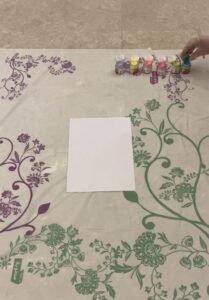
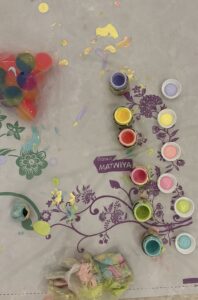
For my “machine,” I used the bouncy balls, paint, gravity, and the movement created when the balls hit the floor. I basically start the process by dropping them, but after that I don’t control where they go.
Several drawing outputs
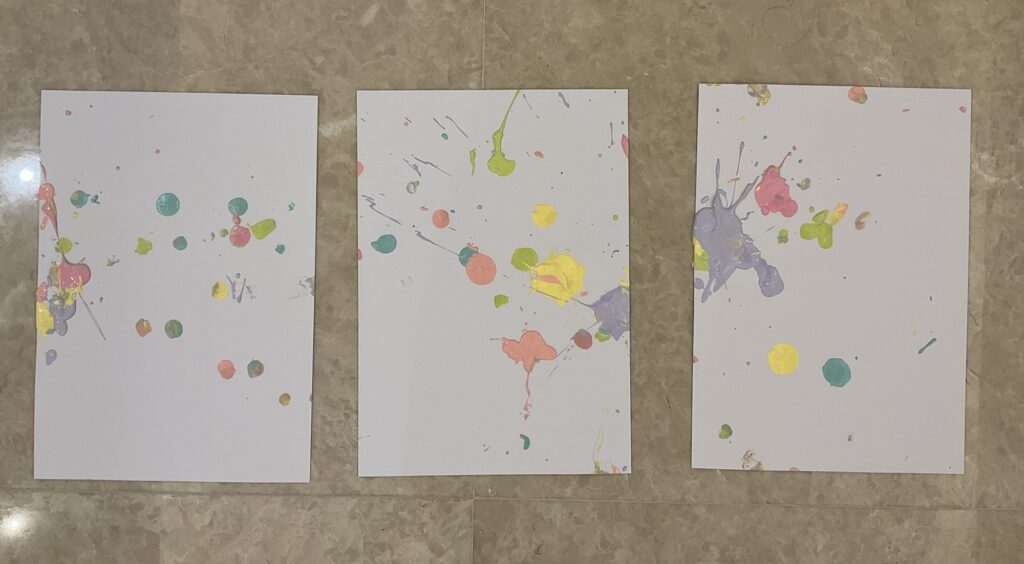
Each drawing came out differently even though I followed the same basic process and tried to drop them in the exact same way and position. Some had more concentrated marks while others were more spread out. I liked seeing how much the results could change without me purposely changing the composition.
Process and challenges
The process was pretty simple, but the hardest part was actually not interfering. Sometimes I wanted to move a ball toward an empty area or add more paint somewhere, but that would defeat the point of the project.
Another challenge was that the balls didn’t always behave how I expected. Some bounced really far, some barely bounced, and the amount of paint on each ball also changed the marks. After a few tries, I realized those unpredictable parts were actually what made the project interesting.
Reflection on control, chance, and authorship
This project made me think a lot about how much control an artist actually needs to have. I controlled the materials, colors, number of balls, and the way they were dropped, but I couldn’t control the exact marks.
Because of that, I don’t think the drawing is completely controlled by me or completely controlled by chance. It’s somewhere in between. I created the situation, but the bouncy balls and gravity decided what happened inside of it.
It also made me question authorship a little. I would still call myself the artist because I came up with the idea and created the rules, but I wasn’t directly making every mark on the paper.
In relation to Sol LeWitt’s Paragraphs on Conceptual Art, where does the “idea” of your drawing reside: in your design decisions, the machine, or the final drawing? Explain
After reading Sol LeWitt, I think the “idea” of my drawing mostly exists in my design decisions. LeWitt says that in conceptual art, the idea is the most important part and that the planning and decisions can happen before the work is actually made.
For my project, the important part isn’t one specific final drawing. It’s the decision to use painted bouncy balls and let their movement create the drawing without controlling them afterward. The machine is what carries out that idea, and the final drawing is basically evidence of what happened.
I think this became even clearer after making several drawings because they all looked different, but I still saw them as part of the same artwork. The thing connecting them wasn’t how they looked. It was the idea and the rules behind them. LeWitt says that a work begins with an idea and that the process of conception and realization is what the artist is concerned with. That connects really well to what happened with my project.