Assignment 1
Concept
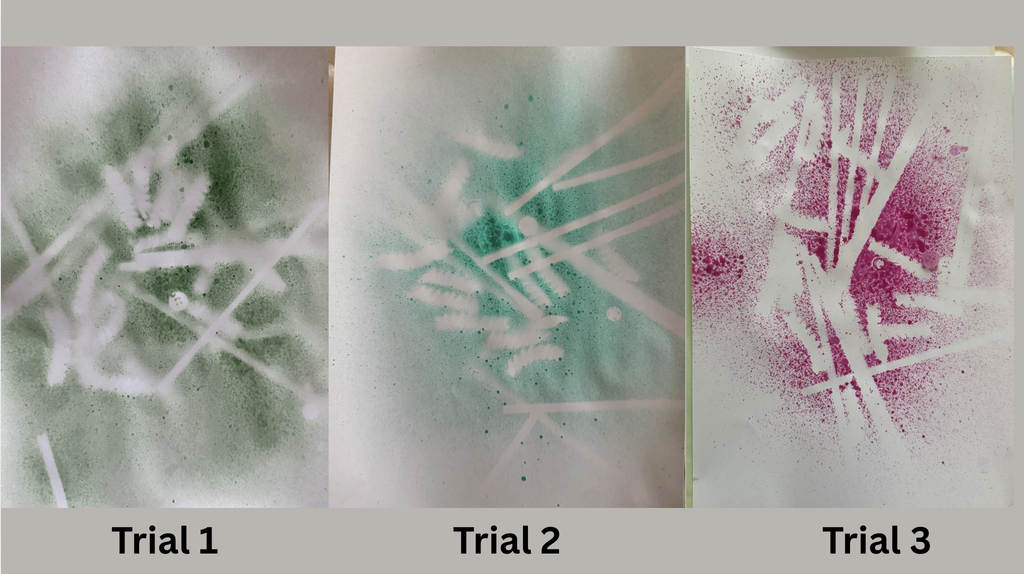
The main concept of my drawing machine is using negative space, different shapes, and different materials to create a drawing through chance. I wanted the system to have some parts that stay fixed, or controlled variables, and other parts that change each time. I start by randomly choosing a paint color. I do this by shaking a box of colors, counting to five, and choosing one without looking. I then mix that color with water in a spray bottle, using around the same amount of water and paint each time. After that, I take a cup filled with different materials, including small wooden sticks, pasta shapes, and buttons, and flip it over onto the middle of the paper. Wherever the materials fall, I leave them there without moving them. I then spray the paper ten times. When I remove the materials, the spaces they covered stay blank, creating the negative space. Because the color and placement of the materials are random, every drawing comes out differently even though I follow the same system.
Photos/video of the machine
Several drawing outputs
Process and challenges
One of the main challenges was making sure that the fixed parts of my system actually stayed fixed. Since I am the person spraying the paint, it would be easy for me to accidentally spray one piece more than another. To solve this, I decided that every drawing would receive exactly ten sprays. I also tried to use around the same amount of water and paint in the spray bottle each time. Another important rule was that once I flipped the cup and the materials fell onto the paper, I could not move or rearrange them. This helped me avoid changing the composition based on what I thought looked better and allowed chance to have more control over the final result.
Reflection on control, chance, and authorship
I think this project has a balance between control and chance. I have control over creating the system, choosing the materials, deciding the amount of paint and water, and setting the rule of ten sprays. However, I do not control which color gets chosen or where the materials land on the paper. Those parts are left to chance. I still see myself as the author of the work because I created the idea, rules, and system, but I am not directly designing every part of the final drawing. The final piece is a combination of my decisions and the random results created by the system.
In relation to Sol LeWitt’s Paragraphs on Conceptual Art, where does the “idea” of your drawing reside: in your design decisions, the machine,, or the final drawing? Explain briefly.
In relation to Sol LeWitt, I think the main idea of my drawing resides in my design decisions and in the system I created, rather than in the final drawing itself. I decided the rules and structure before making the pieces, and once the process starts, I follow those rules instead of changing the artwork based on how it looks. LeWitt explains that in conceptual art, the planning and decisions are made beforehand and that the idea can become “a machine that makes the art.” I think this connects to my project because my rules almost become the machine. I create the system, but chance carries out part of the execution. The final drawing is therefore one possible result of the idea rather than the idea itself. LeWitt also discusses how a pre set plan can reduce decisions made while creating the work, which is similar to why I made rules such as ten sprays and not moving the objects after they fall.