By: Asma Al Murr
Two pens, one motor
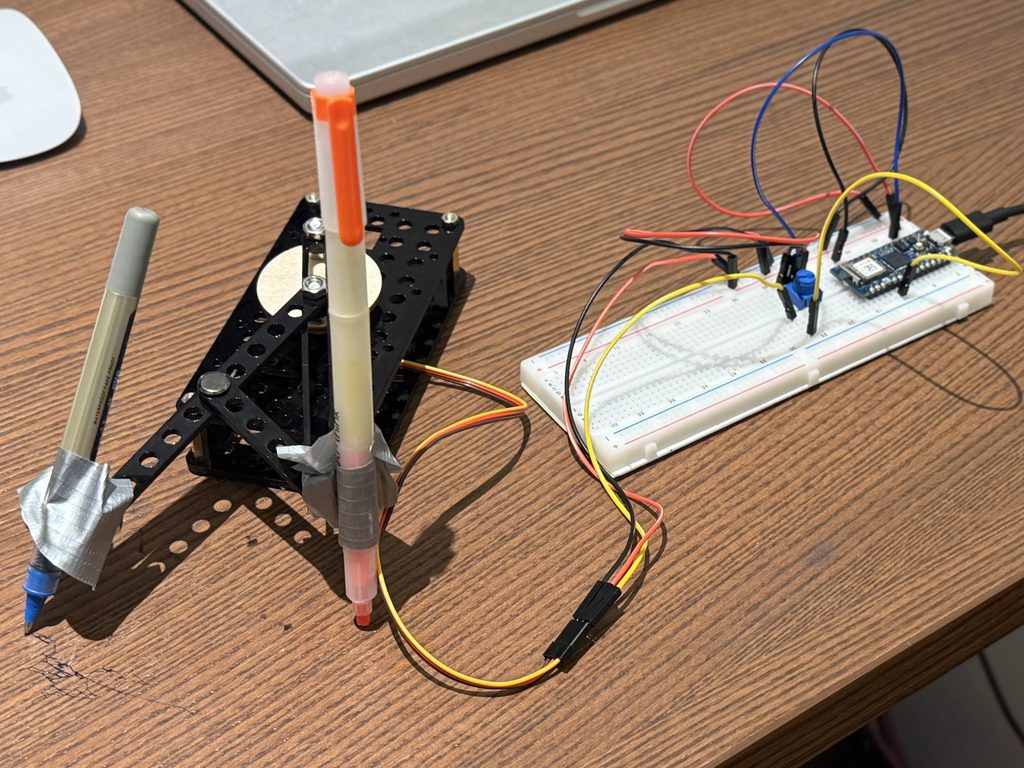
Compressed Video Link Here: https://youtu.be/B_o49-mFXkM
Concept & Process:
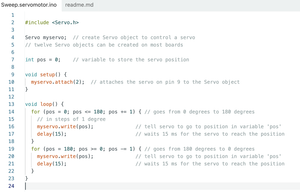
So the basic idea behind this assignment was to build a small scale drawing machine powered by just one servo motor, but I it rigged up to control two pens at once. I ended up going with the sweep code (the classic back-and-forth servo motion) mostly because when I first tested it out, it drew these really clean, smooth semicircles and I immediately thought I can actually turn this into something. It felt like a good jumping off point since the motion was simple but had a lot of potential once I started messing with pen placement, type of pen, and timing. I mainly used the laser cut kit provided in class to build a sturdy two layer base with two arms sticking out to hold both the pens. At first, I started with one pen, but that felt too simple and I knew I could push myself further, so that’s what gave me the idea to figure out a way to still use one motor but change the output completely, with two pens.
Sweep Code:
Drawing Outputs:
Attempt 1: Randomness
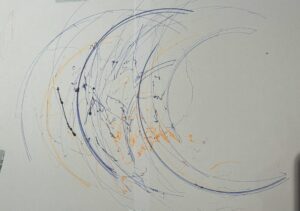
I ran through a couple of different attempts to see what kind of marks I could actually get out of this thing. My first attempt was basically just chaos, I grabbed a bunch of random pens and markers I had lying around and let the machine go, mostly just to see what would happen. It ended up looking super scribbly and layered, honestly kind of like a tangled mess of arcs (you can see all the overlapping lines and stray dots where the pens skipped or dragged). It wasn’t pretty, but it taught me a lot about how the machine actually behaves under different pen weights and pressures.
Attempt 2: (Rainbow)
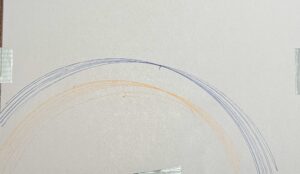
For my second attempt I tried to be a little more intentional and went for a rainbow. This one came out way cleaner since I was only using two pens (orange and blue) and let the sweep motion do its thing without overloading it. If I had more time or a bigger base, I’d want to scale this up and add more pens so I could get a full rainbow with all the colors instead of just two arcs. That’s definitely something I want to try in a v2 of this build.
Process and Challenges:
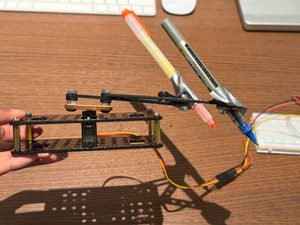
Honestly, the biggest challenge I faced was the weight of the pens and markers against my base. A lot of the pens I wanted to use were just too heavy for the mechanism, and once I tried mounting two of them at once the whole thing got wobbly, unstable, and fell apart. Like it just couldn’t hold the pens steady enough to draw consistent lines. My first instinct was to screw the pens directly into the arm for a more secure hold, but that ended up making things worse because the screws added extra weight right where I didn’t want it. So I ditched that idea and just used duct tape instead, which sounds kind of messy but actually worked way better since it was so much lighter and let the arm move more freely.
Reflection:
Looking back, this assignment really showed me how much small changes in either the mechanism or the code can completely change the output. Something as minor as switching from screws to tape, or slightly adjusting the type of pen I used, made a noticeable difference in whether the lines came out clean and arc-like or messy and scribbly. It’s kind of a cool reminder that with these physical computing projects, the code is only half the story, the actual hardware and how it’s built matters just as much for the final result. If I kept iterating on this, I think focusing on the balance and weight distribution even more would let me get way more precise and intentional drawings out of it.