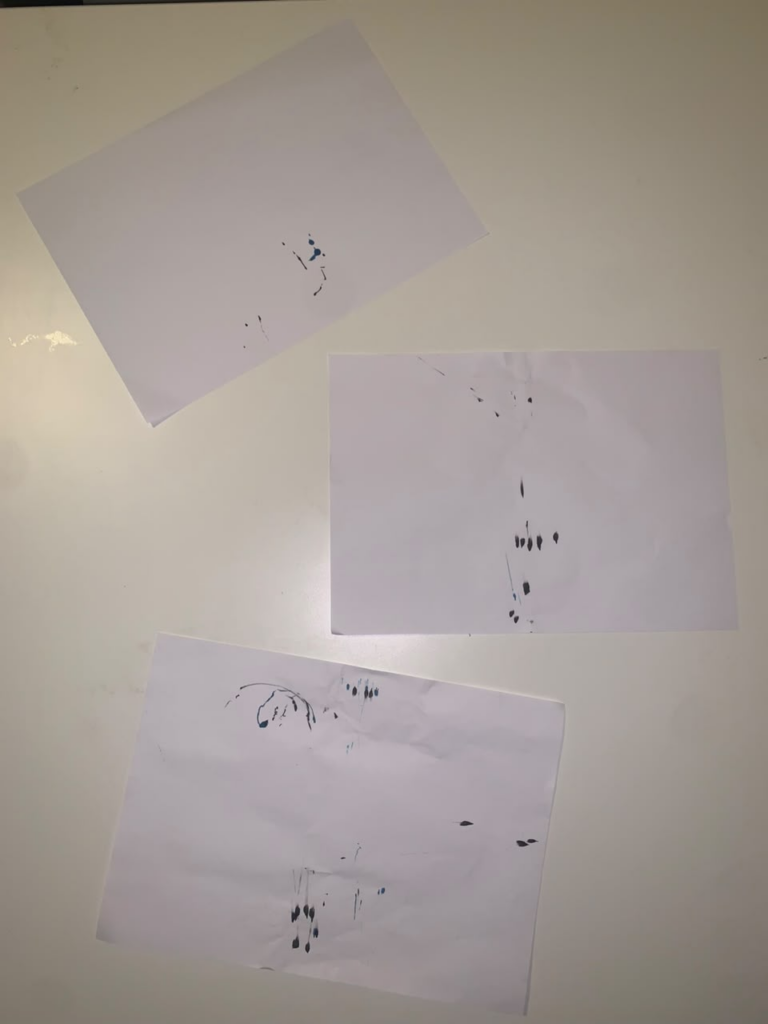
Assignment 1: Low-Tech Drawing Machine!

Concept

For this assignment, I built a Low-tech pendulum drawing machine using a paper cup filled with watered-down paint attached to two strings. The paper cup has a small hole punched into it, allowing paint to drip from it onto the paper underneath as it swings. The idea is that the unpredictability comes from how the material flows across the canvas (in this case, paper), with the use of the swing’s angle, speed, and the type of material and how they each affect the marks left, but not in a way I can fully predict or control in the moment.
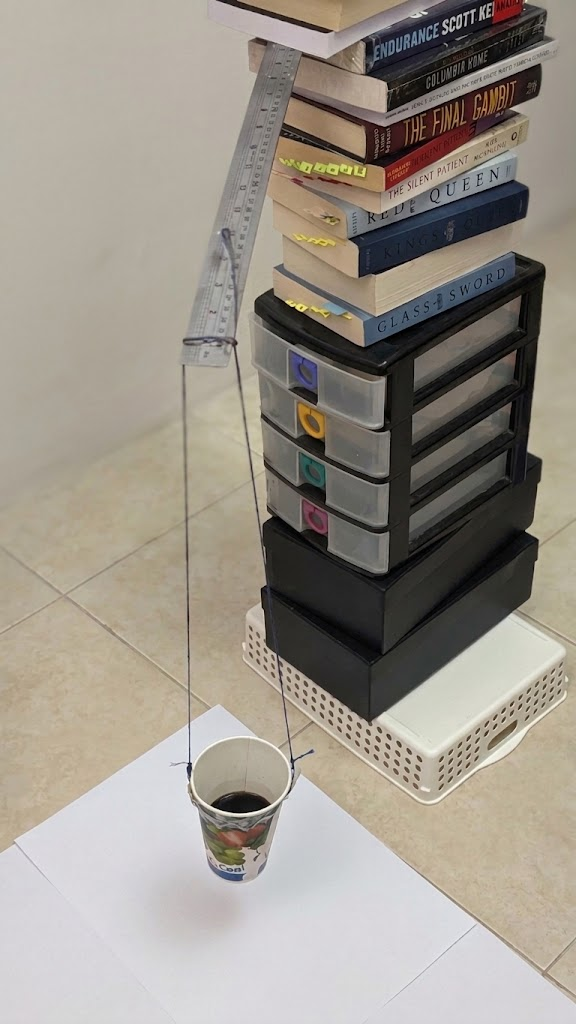
Video

Process and Challenges

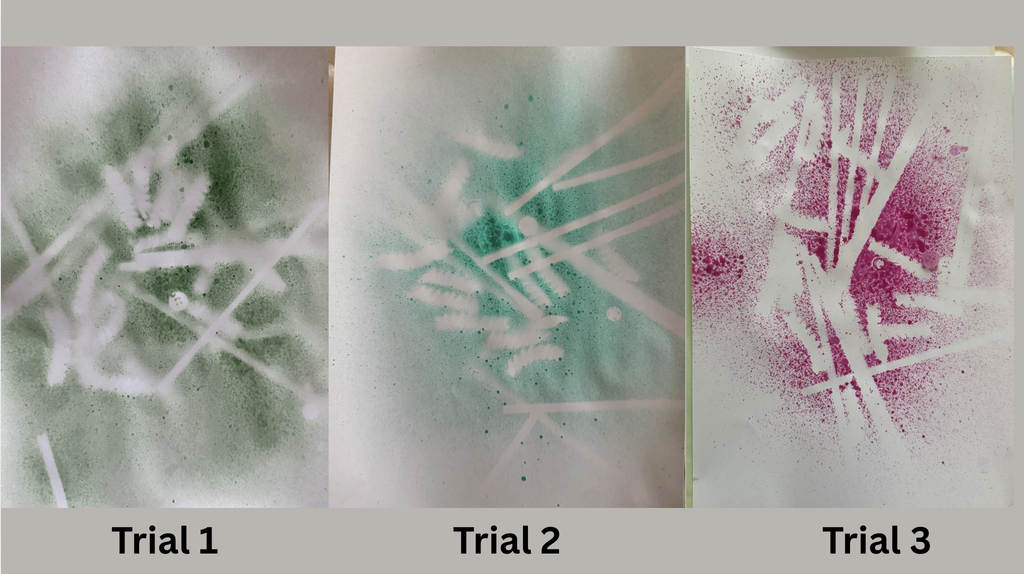
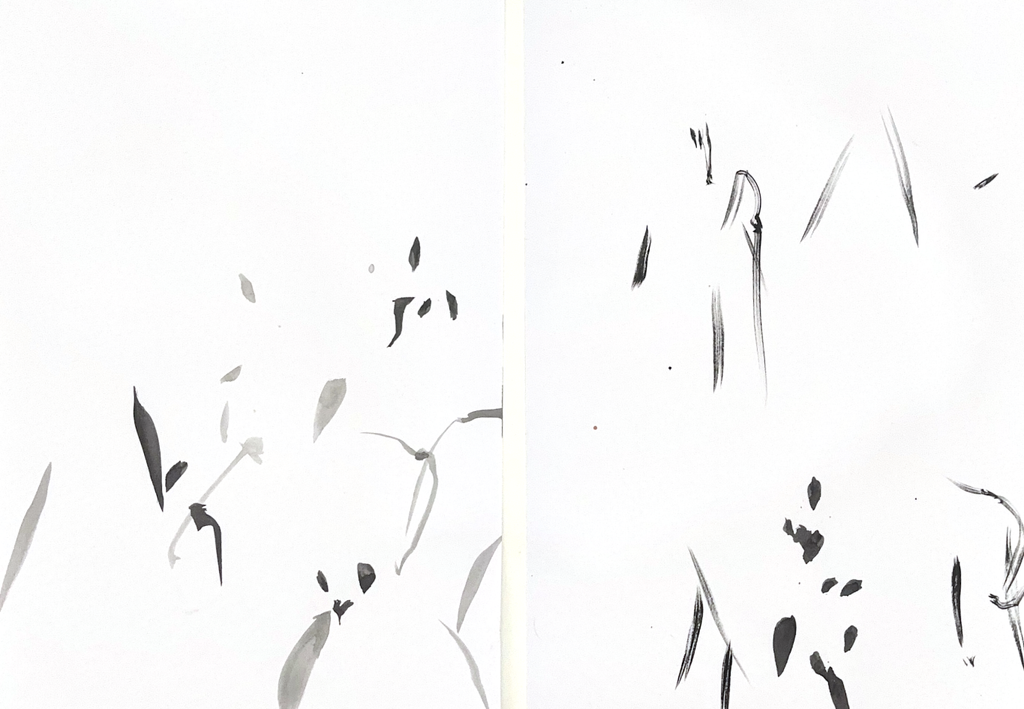
I built the base of my machine by stacking boxes and books into a tower, with a metal ruler laid across the top to suspend two strings. My first attempts used embroidery thread attached to a paint marker, then a paintbrush as drawing tools. However, I found that all three methods caused the friction between the tip and paper kept interrupting the swing, which made short streaks. I thought the reason could be the height of the pendulum but even when I lowered the string so the tip barely grazed the paper, the friction still caught and stalled the motion.
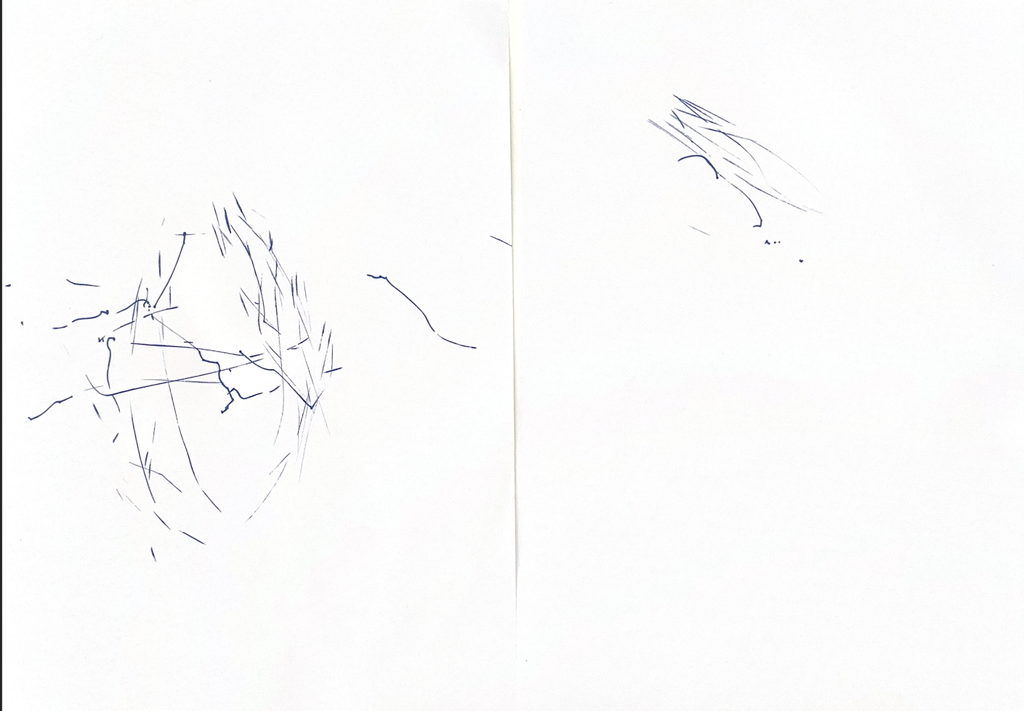
Trial 1 (With a Paint Marker), the swing looped over the same spot, which resulted in streaks.
Trial 2 (With a Paintbrush dipped in ink), short strokes and scattered dots from the brush’s movement.

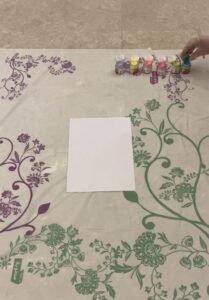
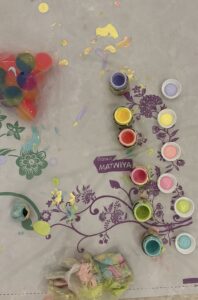
As a result, I decided to experiment further and switched to a paper cup filled with watered-down acrylic paint, with a hole poked in the bottom. This let the paint drip out as the cup swung, and let me control the flow through the angle and speed of the swing. Surprisingly, the biggest challenge was the paint’s consistency (thickness), since if it was too thick, it dropped in blobs instead of flowing into lines, and if it was too thin, the color became barely visible against the white paper.
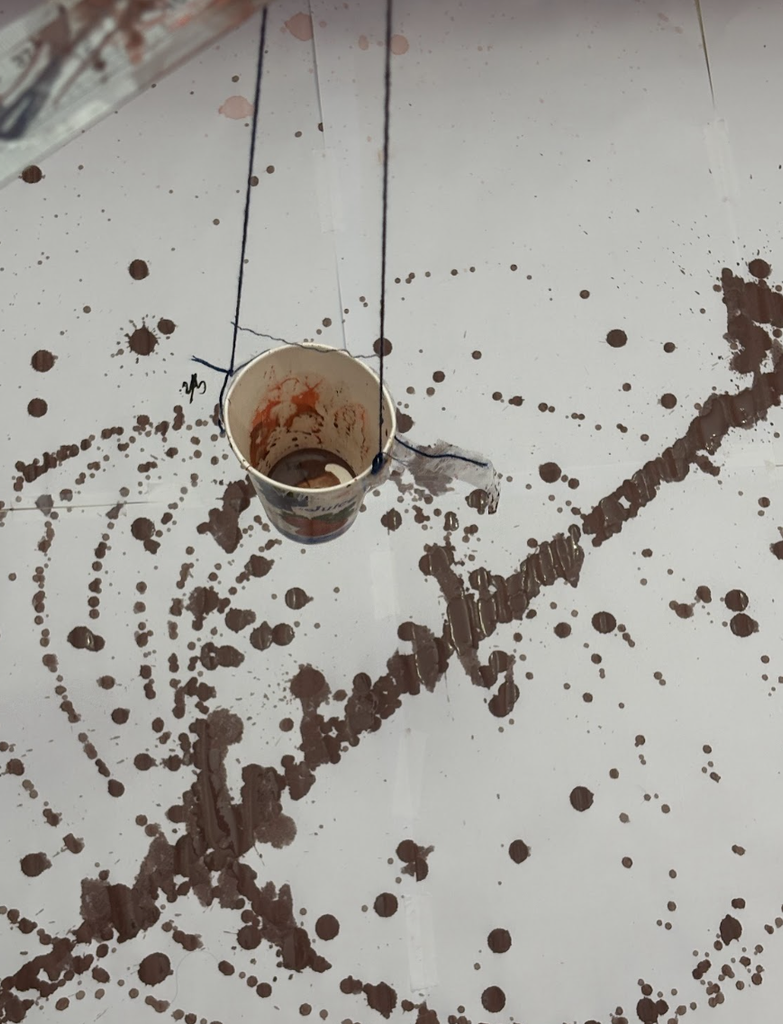
After mixing colors, it thickens the consistency, so I added more water to bring it back to a flowing consistency. In addition to this, taping and releasing the cup was also tricky, since paint started leaking the moment the tape came off, so I had to move quickly once I started.
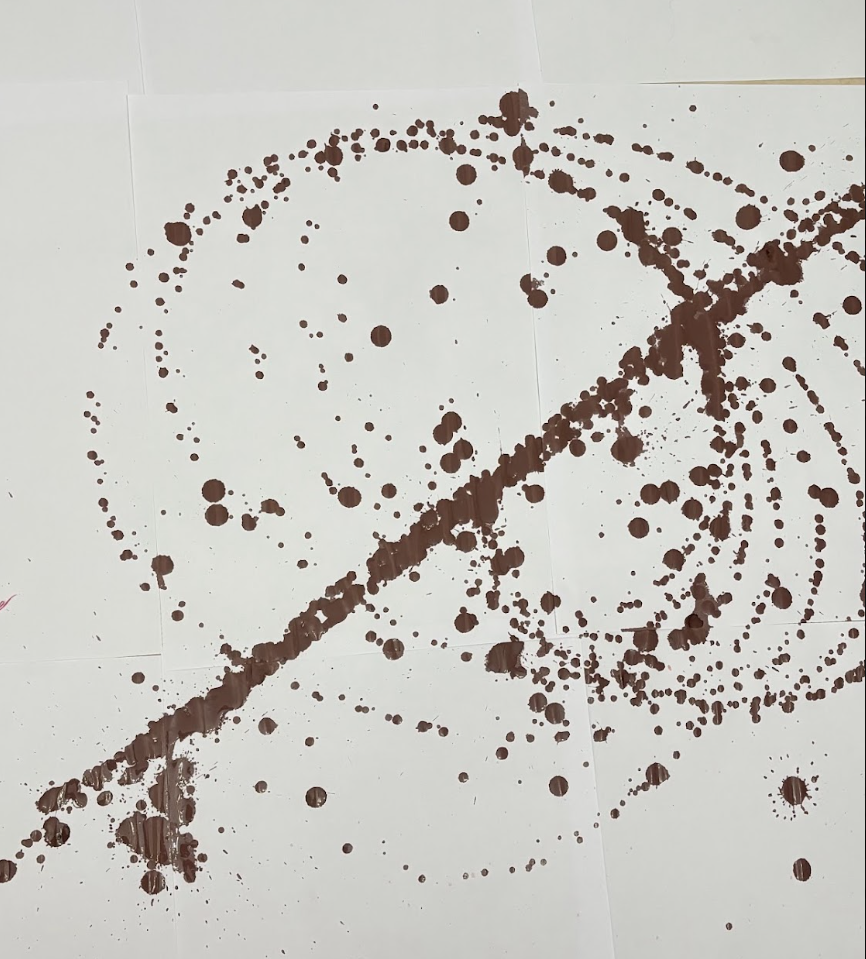
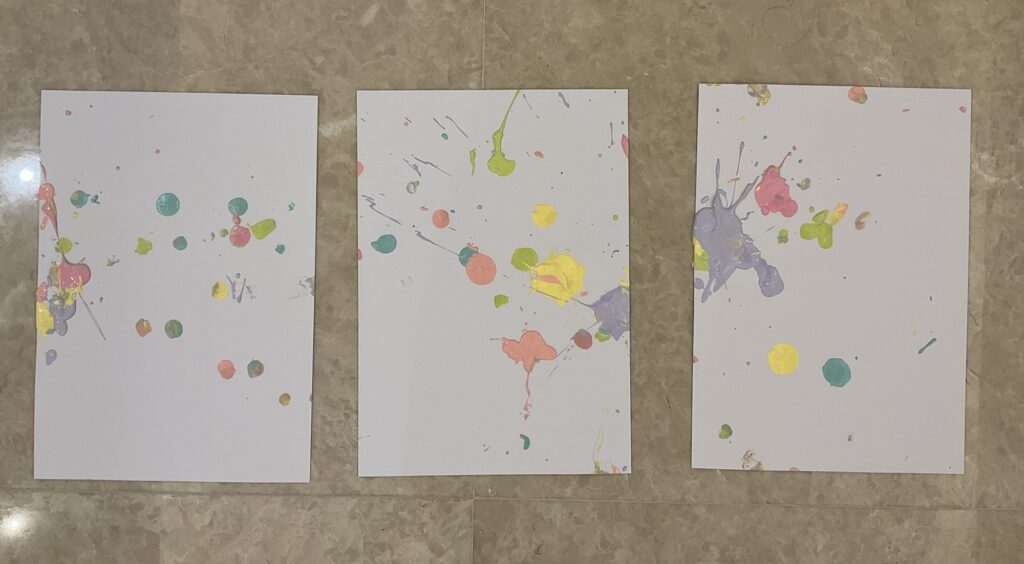
Final Result with paint

Reflection

In relation to Sol LeWitt’s Paragraphs on Conceptual Art, the “idea” of my drawing resides in the machine and my design choices since the pendulum system itself was set from the start, though it took some exploring to find what tool to pair it with, but once running, the machine determined the specific marks I couldn’t control.

Sol LeWitt in his Paragraphs on Conceptual Art argues that once an artist sets the basic rules of a plan, the fewer decisions made afterward, and removing the arbitrary and the subjective from the process (13). In my case, I only arrived at using a cup of paint after testing a paint marker and a paintbrush. Even once I landed on this tool, I kept changing paint consistency, switching colors, re-thinning the mixture.

In addition to this, he says the basic form used should be simple and uninteresting, so the focus stays on the arrangement it creates, not the object itself (LeWitt 13). In my case, the pendulum’s swing isn’t interesting on its own, but the marks it produced are. He also argues that the in-between steps of making art, like testing, adjusting, and failed attempts, matter just as much as the final piece, since they show the artist’s thought process, which is sometimes more interesting than the final product (LeWitt 14). Looking at my own process this way, it taught me that I figure things out by physically testing them to see what the results are like.
assignment 1 – low tech drawing machine

My concept comes from the motion of doing simple things daily. I tried to get inspiration from mechanical things we utilize everyday and after a session of brainstorming I got up from my chair and opened my door. But there it was, that motion of holding the door handle and pushing it down inspired me to trace the arch that forms from moving this handle. So I attached a pen to the handle and tried to trace that motion

I unfortunately do not have paper and couldn’t get access to it as there aren’t bookstores near the area I live in (I live off campus) even though I could swear I had a note book somewhere. I will figure this out on Monday as I buy a notebook from the bookstore for this purpose.

Revision after getting paper:

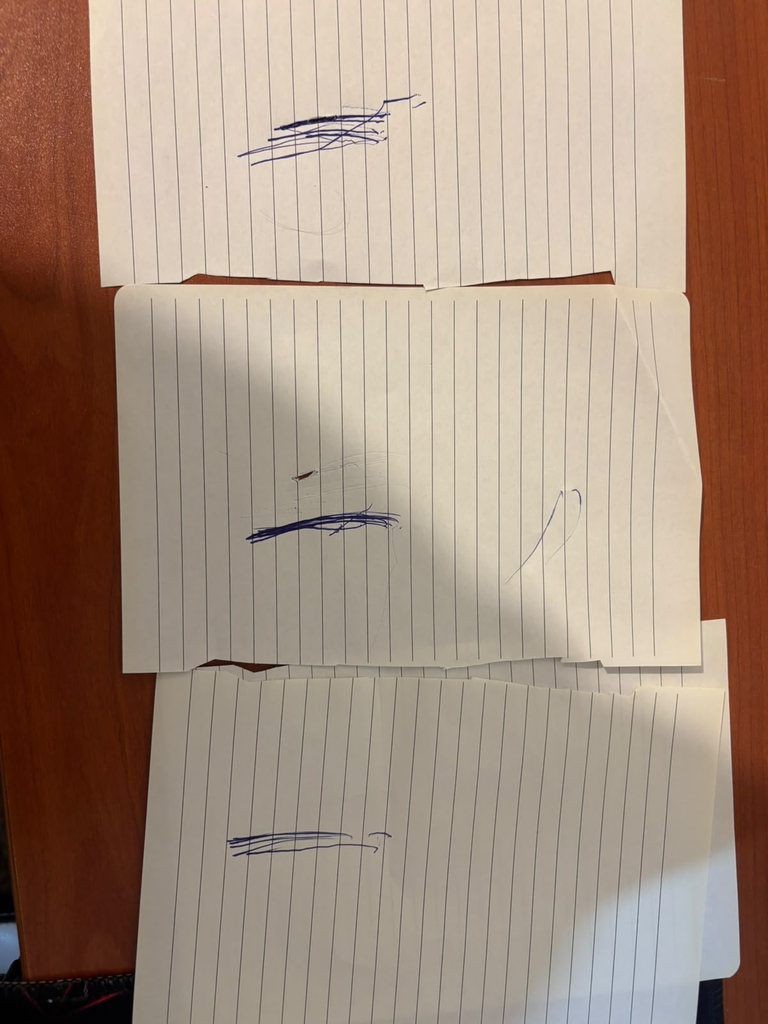
These drawings are ordered from top to bottom as first to last. The first iteration was pretty chaotic and it scratched my door so that’s 500 AED i gotta pay for the landlord at some point, the second iterationi got the hang of the motion more and put the right amount of pressure on the pen and the motion was seamless.

To be honest this is not what I expected AT ALL. I expected a smooth curve that looks like an arc thats situated on the same spot, but I instead got a lot of jagged and staggered lines, which is interesting. What is interesting to me also is that the drawing could really scale up or down depending on where you put the pen on the handle, say you put it directly on the center of the knob, it wouldnt move at all, while on the other side a clear arc will form.

Some of the challenges that I faced is genuinely the simplicity of the assignment. I found it really hard to think of something low tech and because of the video we saw during lecture of a pen attached to a fan, my brain was fixated on using a machine that has a perpetual motion that I can replicate like the fan video. I am happy that I instead came up with an original idea of using the door handle and didn’t tunnle vision on the video we saw.

my other idea was dipping a marble in a jar of ink and spinning it in a bowl with a paper inside and trace this motion, but I found the concept of the door handle more appealing to me.

Thinking about control, chance, and authorship in this assignment, I’d say I’m mostly in control but I did leave room for a little bit of chance. I decided the handle, the pen placement, and the general shape of the motion, so the core idea is fully mine, but the exact line that gets traced depends on small things I can’t fully predict, like how steady my hand is when I press the pen against the handle or how the pen reacts to the material of the paper on the door. So even though I set up the whole system, the actual mark has a bit of its own personality that comes out once I let it run. In terms of authorship, I still think of myself as the artist here even though the handle is technically doing the “drawing.” I’m the one who noticed the motion, chose it over other ideas, and built the mechanism to capture it, so the authorship comes from that decision-making process rather than from physically holding the pen and drawing the line myself. It’s kind of similar to what LeWitt says about the artist selecting “the basic form and rules that would govern the solution of the problem,” where after that point, the fewer decisions I make, the more the piece is really about the idea instead of my hand.

The idea of my drawing definitely comes from the design decisions I made and not the machine or the final drawing itself. The handle and pen setup is really just a tool, it just repeats whatever motion I already picked out for it. The final drawing hasn’t even happened yet since I don’t have paper, but I already know exactly what the concept is and how it will look, which kind of proves that the idea existed before any physical form was made. LeWitt talks about how “the idea becomes a machine that makes the art,” and I think that fits here because once I made the decision to use the handle, the rest is just letting it play out.

Assignment #1 (Low-Tech Drawing Machine)

Modified RC Car

By: Asma Al Murr

Video of how it works:

Concept

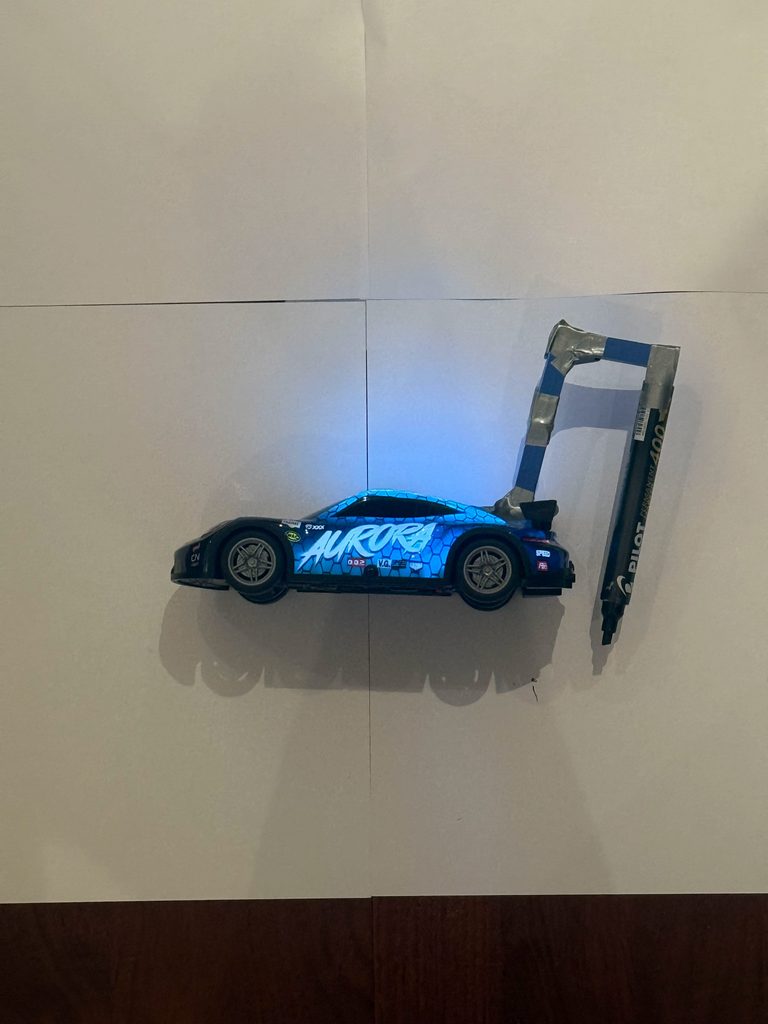
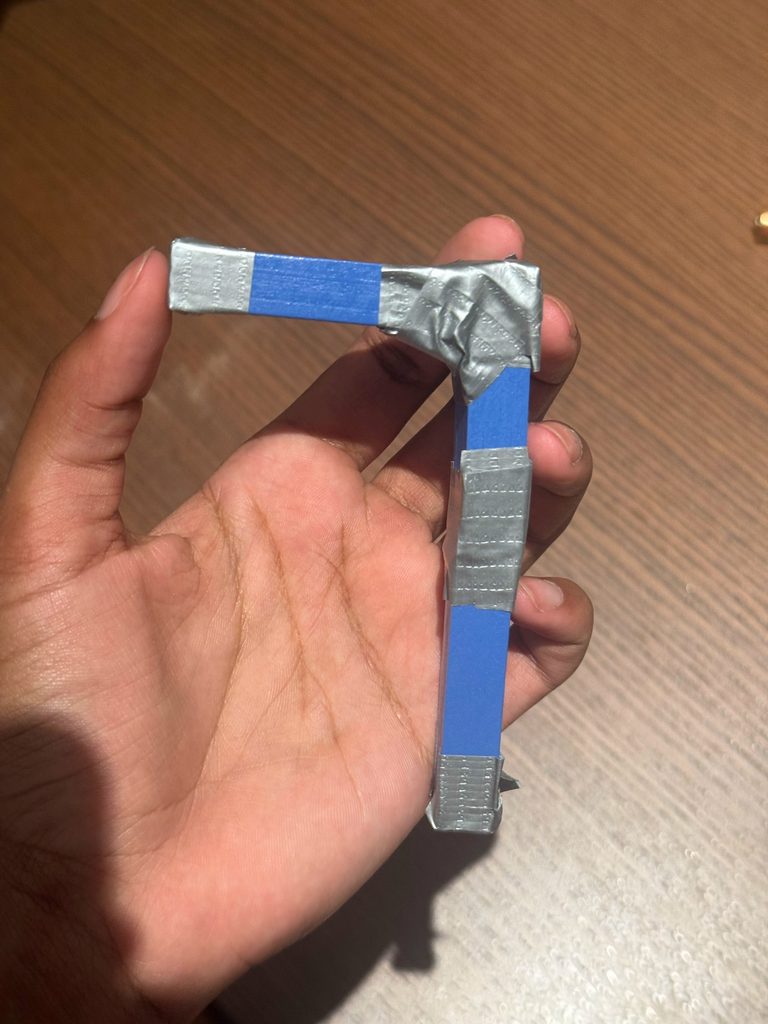
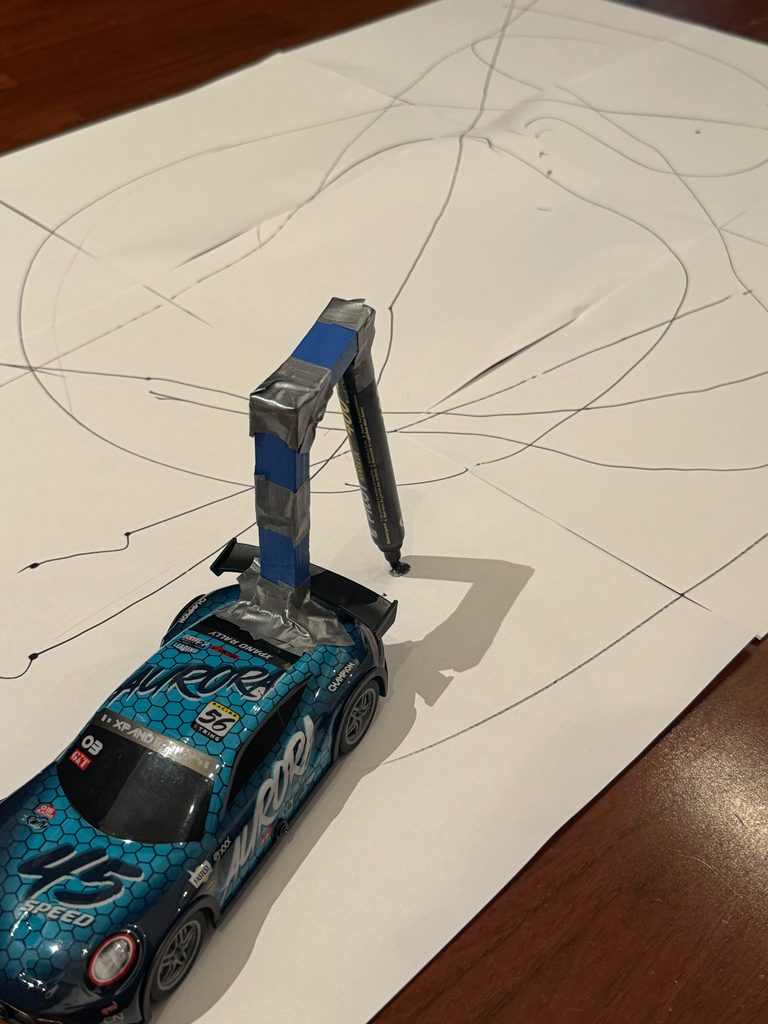
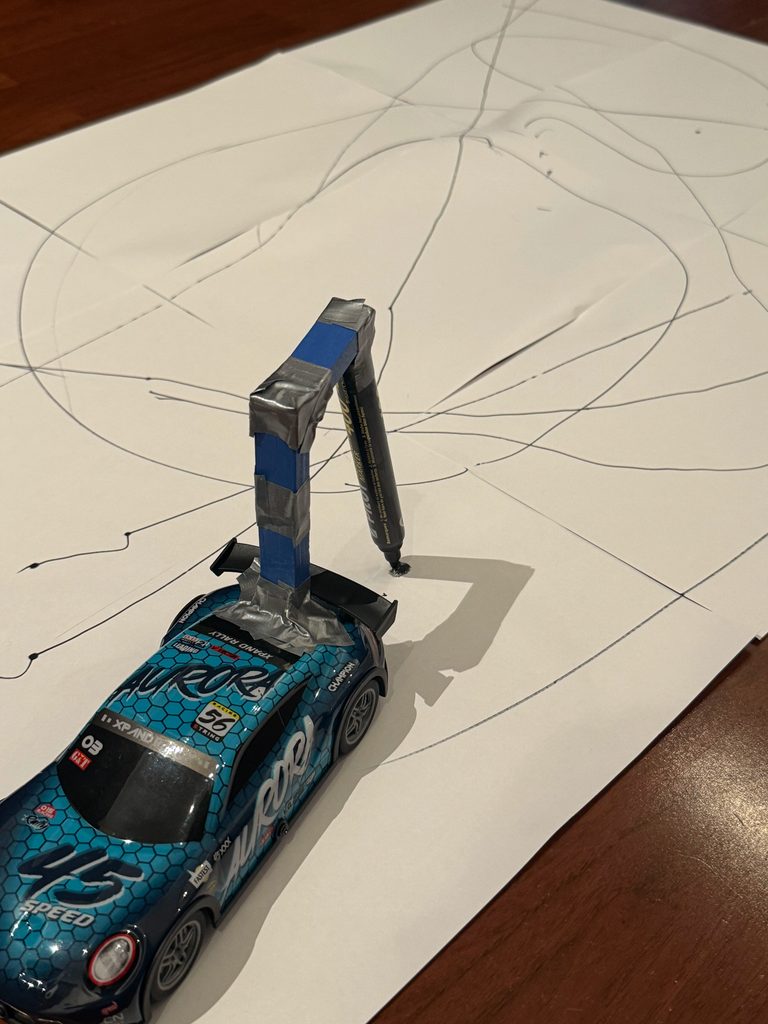
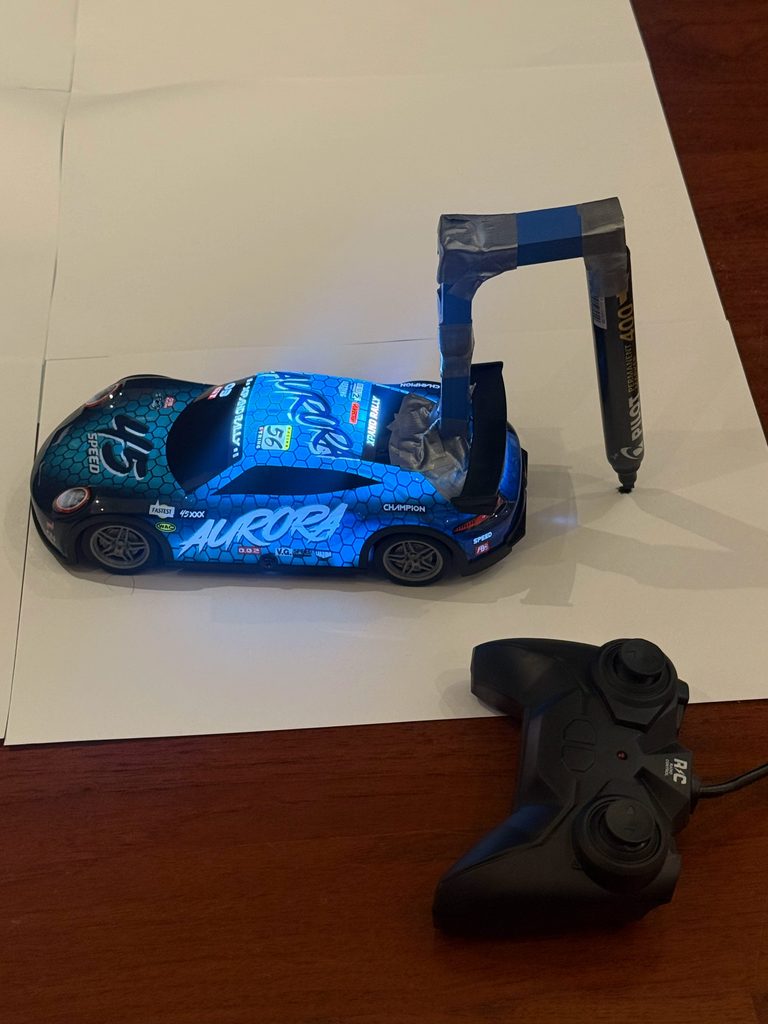
For this assignment I took my brothers old RC car and turned it into a low tech drawing machine by taping a homemade wooden arm to the back of it. The arm is made out of three Jenga blocks stacked together with duct tape, going up and then bending back down so a marker hangs off the end, angled toward the paper. Basically the idea was that as I drive the car around, the marker drags/bounces along and draws whatever path the car takes, but not perfectly (the wobbly arm and the car’s own movement add a bunch of randomness so I’m not really in full control of the line) but it still turned out pretty good. I liked this because it’s kind of a low-tech way to get at that idea of using a machine to make marks instead of just drawing by hand.

Process and challenges

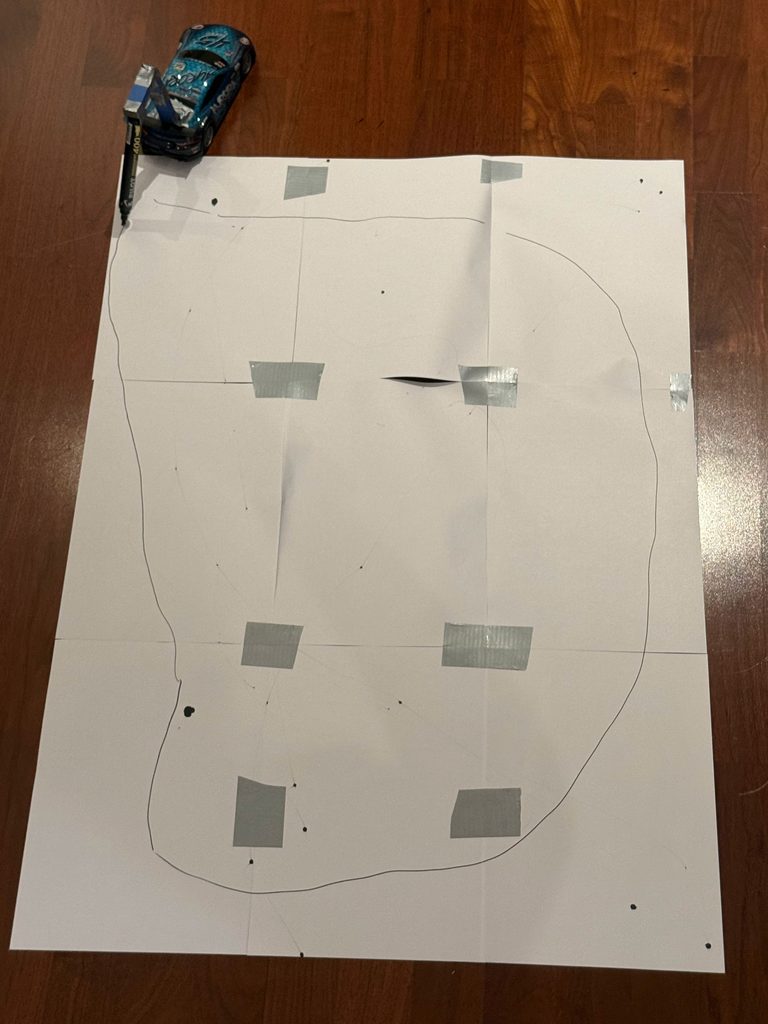
Honestly the biggest problem I ran into had nothing to do with the car, it was the marker and the specific way I had to angle it with enough pressure to actually be visible on the page. I started out with a regular pen, but it turned out that pen only actually put down ink if it hit the paper at a hard angle with a lot of pressure, so half the time I’d drive the car around and get basically nothing, or just a faint scratchy line that barely showed up. That wasn’t the kind of unpredictability I wanted, it wasn’t adding anything interesting, it was just failing. So I swapped it for a black permanent marker instead, which lays down ink way more consistently no matter what angle it’s hitting the paper at, and that fixed most of the problem. Building the arm was also trickier than I expected because duct tape isn’t exactly a stiff joint, so every place where the Jenga blocks connect has a little bit of wobble in it, and since there are three blocks, all those little wiggles add up by the time you get to the marker at the end. So even small bumps or turns from the car turn into much bigger swings at the tip. I also had to mess around with how tight I wrapped the tape and what angle I set the marker at so it would actually stay touching the paper instead of skipping off during turns or digging in and dragging when the car slowed down. Also another major issue was SPACE! Driving around an RC car requires more space than just a regular piece of paper. So what I did was take 9 sheets of A4 paper and taped them together to give the car more room to move without ruining my floor. 

Reflection on control, chance, and authorship

Thinking about what I actually controlled versus what I didn’t: I picked the car, built the arm (how many blocks, how I taped them), I picked the marker, and I steered the car. But once the car was actually moving, I lost control over the exact lines it produced. How much each taped block flexed at any given moment, or how the marker’s angle shifted mid-turn, wasn’t really up to me, and sometimes the marker wouldn’t get enough pressure against the paper to leave a continuous line, so it left random gaps instead. The car’s physical limitations added their own kind of chance, too. Since it isn’t built for sharp turns, drawing anything like a square or rectangle was basically off the table so I ended up mostly getting straight lines and loose curves or squiggles instead. I also noticed that wherever I stopped the car, the marker would sit in place just long enough to bleed into a little ink blot, so the drawing ended up dotted with these small dark patches marking every pause. And since the car could only move forward, not backward, I couldn’t retrace a line or correct a mistake once I’d made it, which made every move final and took away the chance to “undo” and pushed even more of the results out of my hands.

Relation to Sol LeWitt

This assignment connects to what LeWitt says about “the idea becoming the machine that makes the art” which I actually learned in the course Understanding Interactive Media. The machine is basically the tool that carries out that idea, and the drawing is just proof that it happened. When we look at LeWitt’s thinking, the actual “art” isn’t the drawing itself, it’s the system behind it. So if someone else built the exact same setup using my instructions and ran it themselves, the drawing they got would look different in the details, but it would still count as my piece. That’s because what I actually created was the idea and how it works, not the specific lines that ended up on the paper. The arm and car setup is the “machine,” and it’s carrying out a plan I made (wooden arm and a marker that reliably makes contact) without me controlling every single line by hand.  I think the idea in this piece lives mostly in the design choices I made before I even started drawing anything. For example choosing to use three loosely taped blocks instead of one stiff arm, and figuring out the marker issue so the randomness I wanted would actually show up as ink instead of just not drawing at all. Even switching the pen wasn’t really changing my idea, it was just making sure the idea could actually come through on paper instead of getting lost because the tool wasn’t cooperating. So in LeWitt’s terms, I’d say the idea is in the setup/design, and the final drawing and art is just what’s left over after the system (machine) runs.

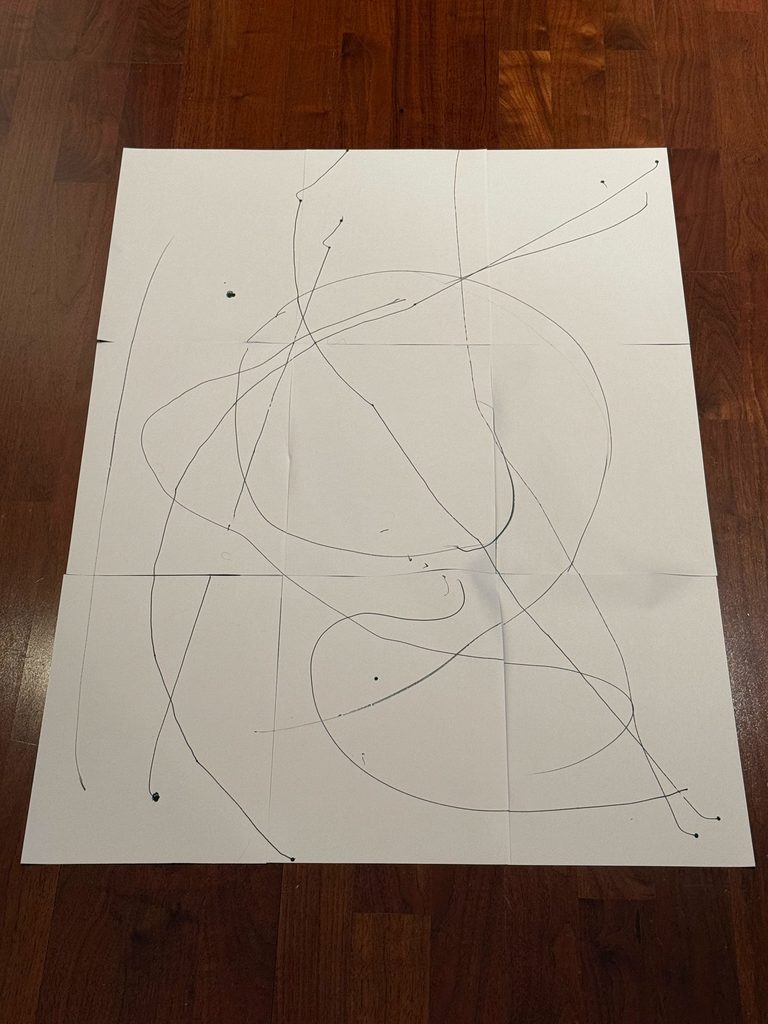
Results:

attempt 1: (total randomness)

attempt 2: (trying to draw a circle)

Assignment 1 – Low-tech Drawing Machine

Concept

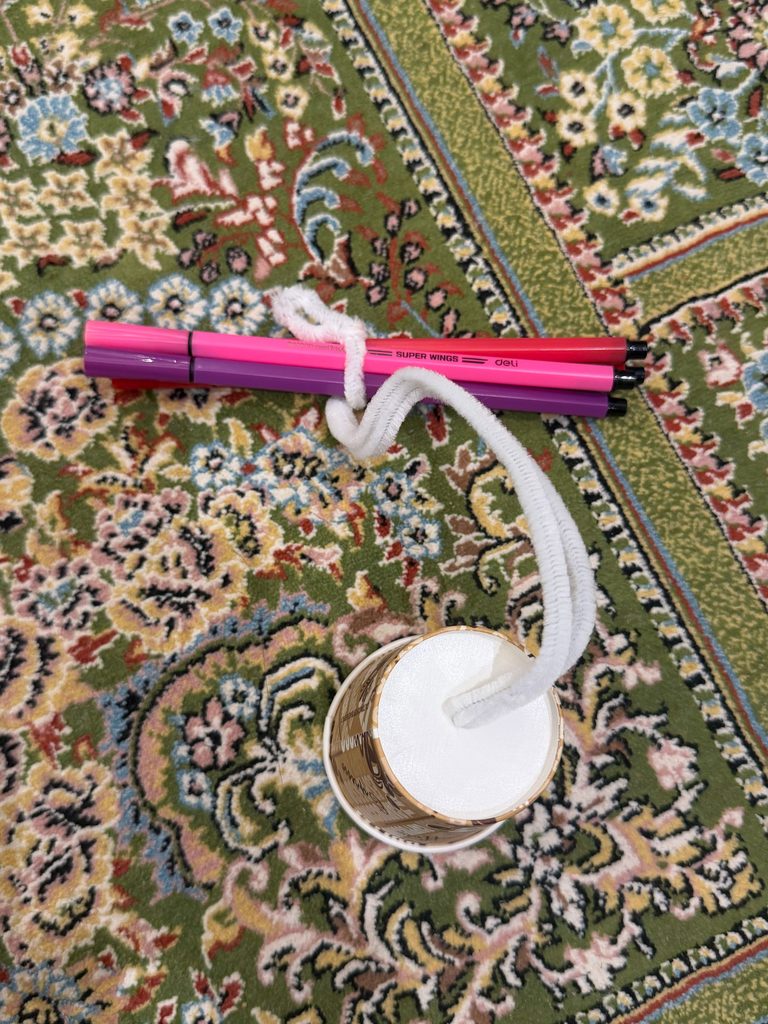
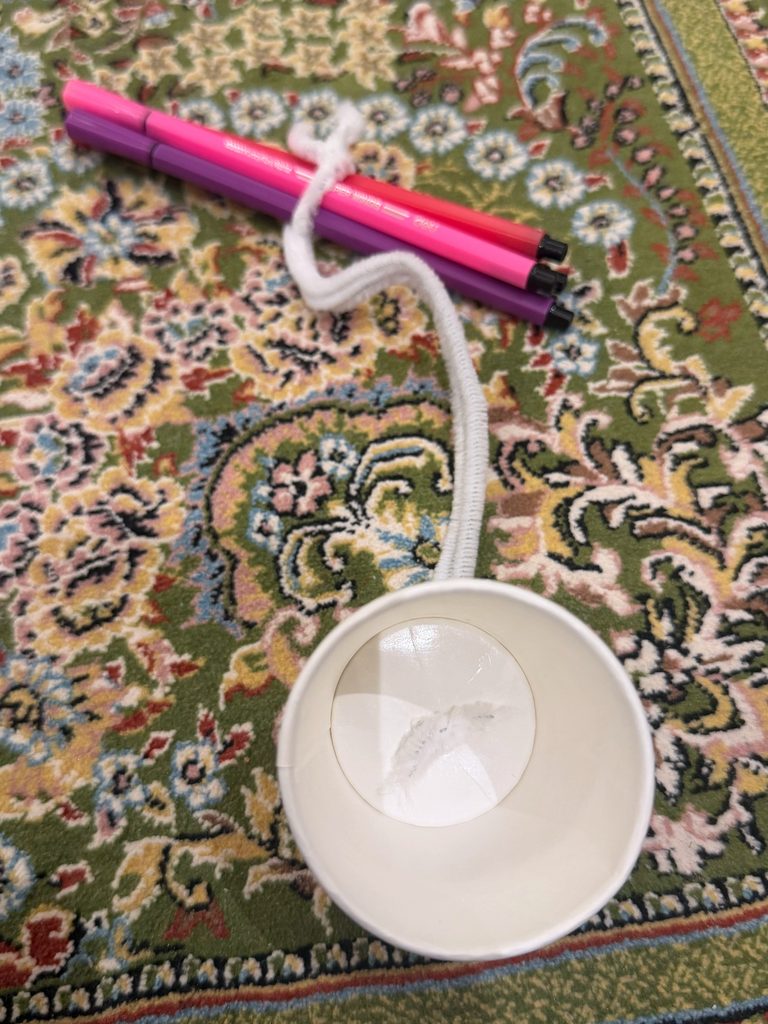
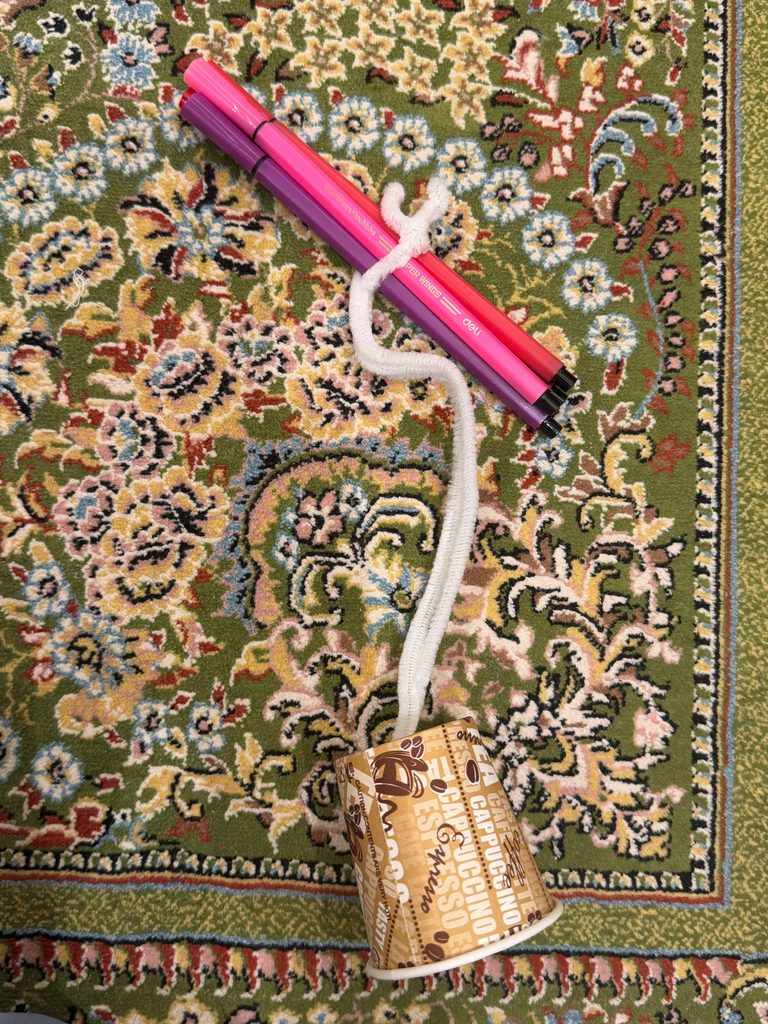
For this project, I made a small drawing machine using a paper cup, two pipe cleaners, and two markers. I wanted something simple that still created drawings I couldn’t fully control. I attached the pipe cleaners to the cup and the markers, so they acted like flexible arms. When I swing the cup over the paper, the pipe would swing the markers, and the markers leave random lines. Even though I’m the one holding and moving the cup, the pipe cleaners make the motion unstable, so the final drawing is never exactly what I expect.

Photos / Video of the Machine

Video:

Photos:

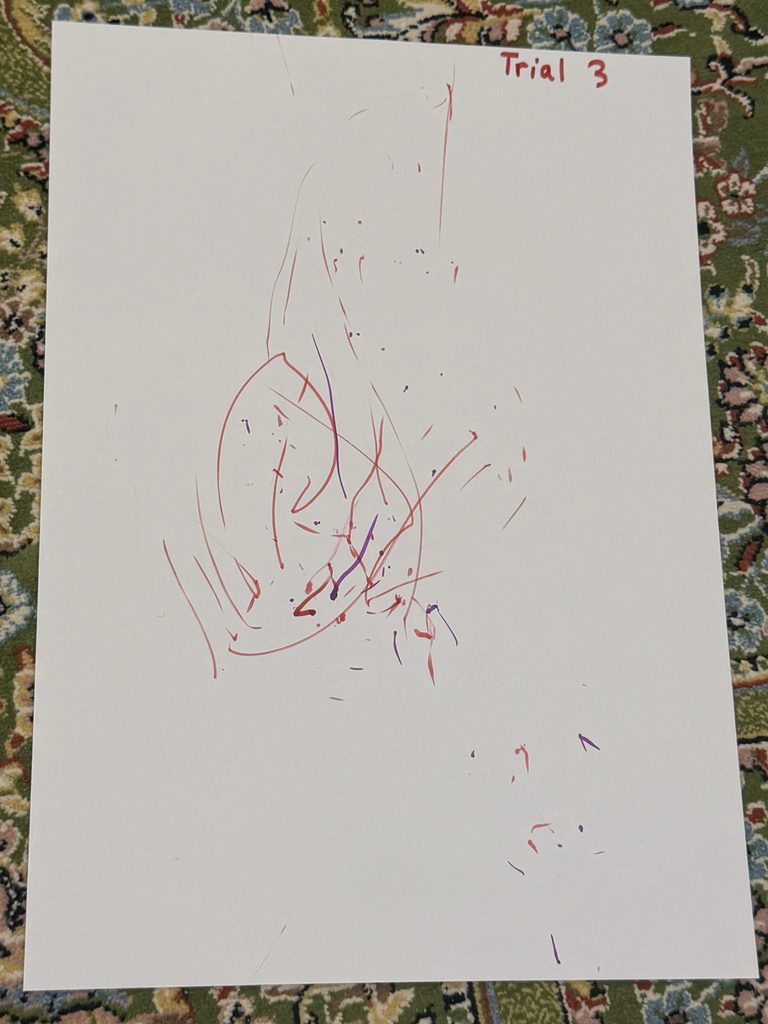
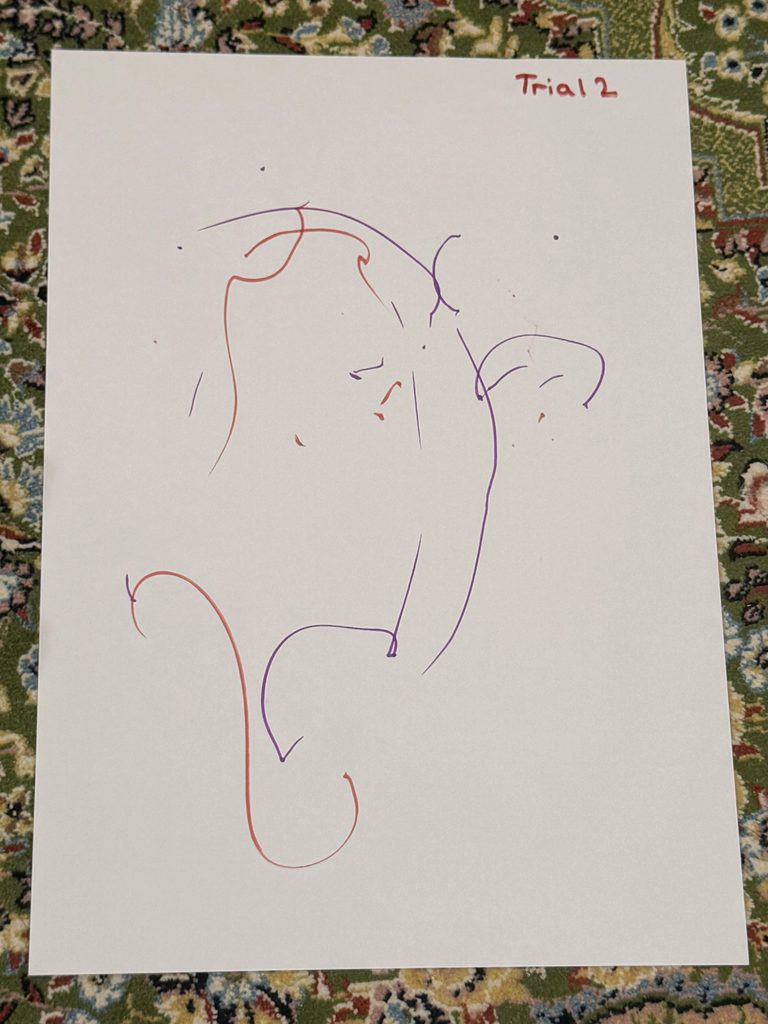
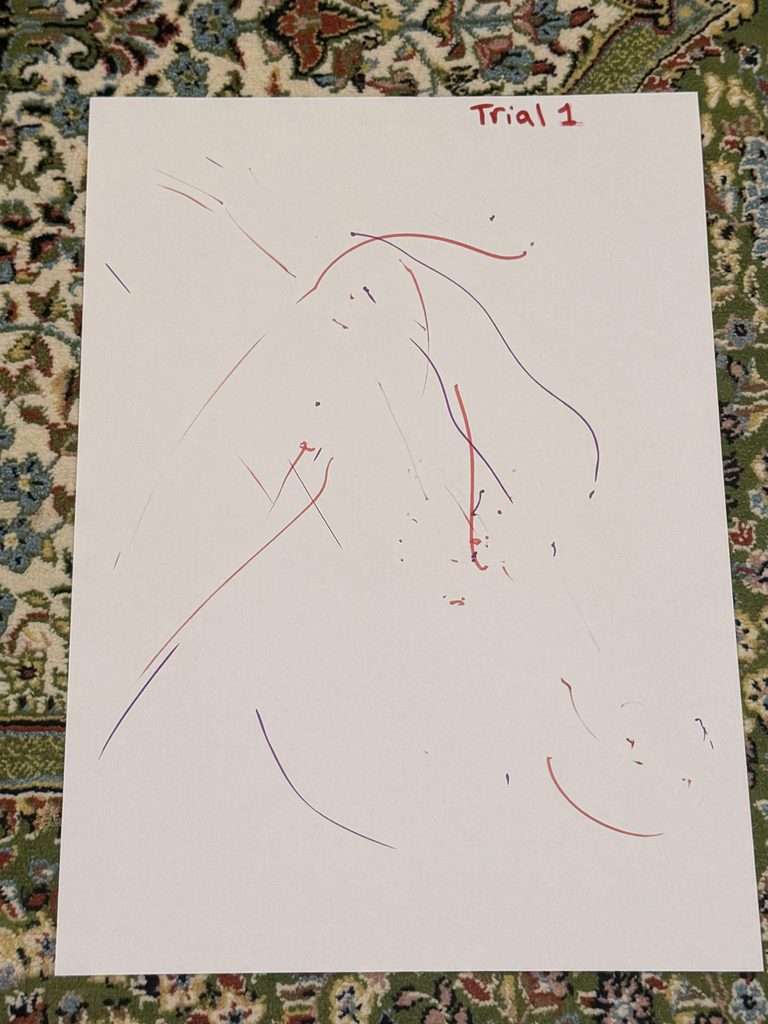
Drawing Outputs

Each drawing looked different even though I used the same materials and the same motion. When I swung the cup gently, the lines came out soft and curved. When I moved it faster, the pipe cleaners shook more, and the lines became messy and overlapped. Sometimes the markers touched the paper evenly, and other times they bounced or skipped. These small changes made every drawing unique.

Process and Challenges

The machine was easy to build, but getting it to work the way I wanted took some trial and error. Using two pipe cleaners made the arm more flexible, but also harder to control. Sometimes the markers didn’t touch the paper at the same time, or the cup tilted too much. I had to adjust the pipe cleaners and try different ways of swinging the cup. Another challenge was letting the machine behave naturally instead of trying to fix the lines. Even though I was holding the cup, I tried not to guide the markers too much. Once I let the pipe cleaners move freely, the drawings became more interesting.

Reflection on Control, Chance, and Authorship

This project made me think about how much control I actually have. I control the materials and how I start the movement, but the pipe cleaners add chance to the drawing. I never know exactly how they will bend or shake, so the final marks are partly random. I still see myself as the author because I designed the system and decided how it works, but the machine also plays a big role in the final result. The drawings feel like a mix of my intention and the unpredictable behavior of the pipe cleaners.

Sol LeWitt: Where the “Idea” Resides

After reading Sol LeWitt’s Paragraphs on Conceptual Art, I realized that the “idea” of my drawing is not in the final image. It’s in the system I created. LeWitt writes, “The idea becomes a machine that makes the art.” This connects directly to my project. The idea behind my machine is attaching two pipe cleaners to a cup and letting the movement create the marks. Once I start swinging the cup, the machine carries out the idea for me. The drawing is only one possible result of that system. This helped me understand that the important part of my project is the concept and the rules, not one specific final drawing.

Assignment #1 – Low-Tech Drawing Machine

Pencil Spin

Concept
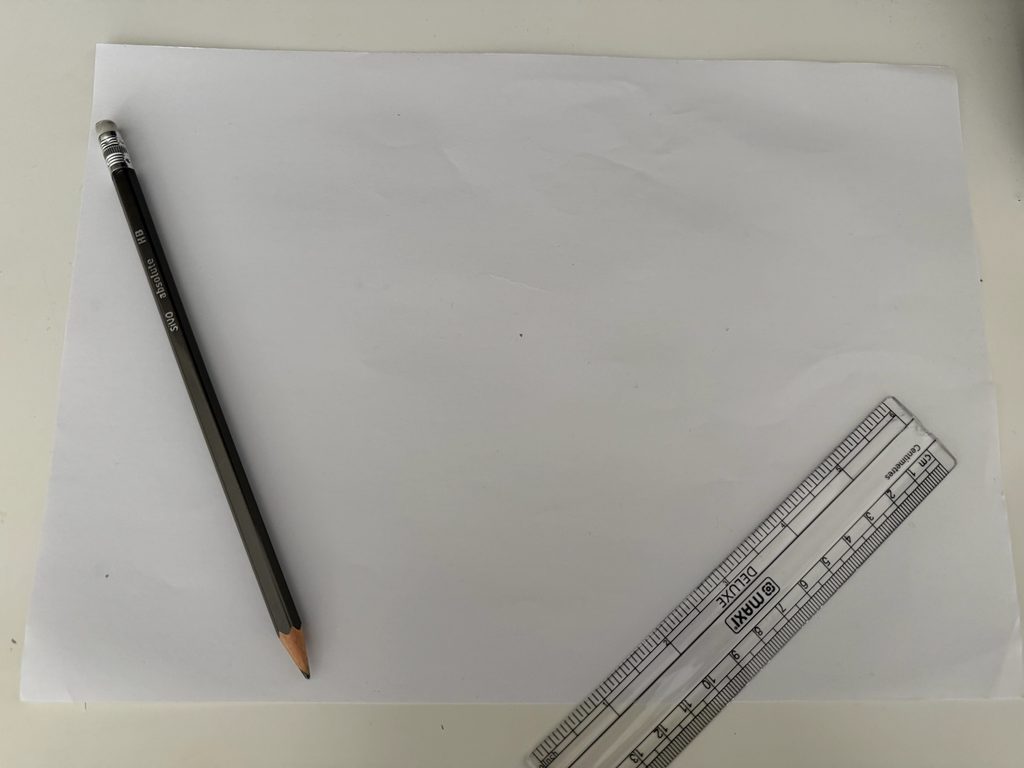
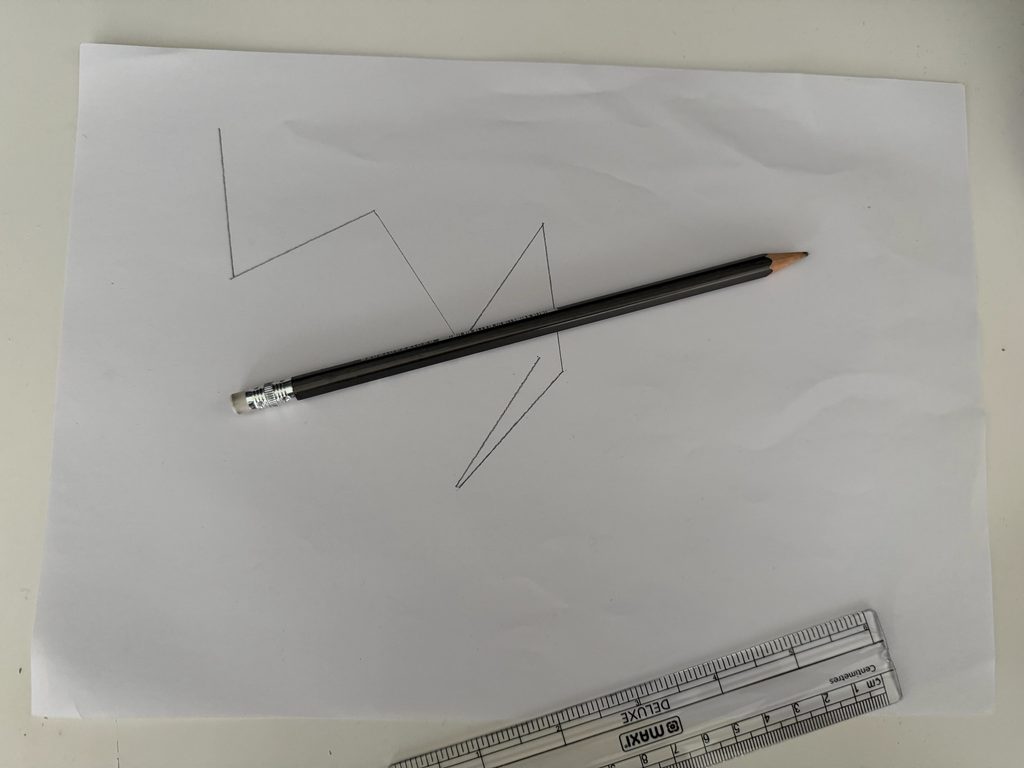
I created a simple system for my drawing machine that only requires a pencil, ruler, and paper. Instead of choosing where I wanted each line to go, I let the pencil decide. I would lay the pencil on the paper, and spin it like a bottle. I drew a straight line in the direction the tip of the pencil was pointing when it stopped. Then the end of that line became the start of the next spin.

Before I started, I came up with some rules that I had to follow throughout the drawing:

  • Each line had to be the same length (5 cm)
  • The direction had to be determined by the pencil spin.
  • I couldn’t change the direction because I thought another direction would look better.
  • After drawing the line, I had to start the next spin from its endpoint.

The purpose of the system was to take away some of my control over the final composition. While I was physically making the marks, I was no longer deciding where exactly they went.

Process
I started by marking a dot in the centre of the paper, and then spinning the pencil to see which direction to draw my first line. Wherever the sharpened end pointed when it stopped became the direction of my first line. Then I continued the same process of spinning, drawing, and moving to the new endpoint.

At the start I noticed that I kept wanting the drawing to go in certain directions, especially when I felt that one area was becoming too crowded or when I thought another direction would make the drawing look more balanced. However, I followed the system exactly instead of making decisions based on what I thought would look better.

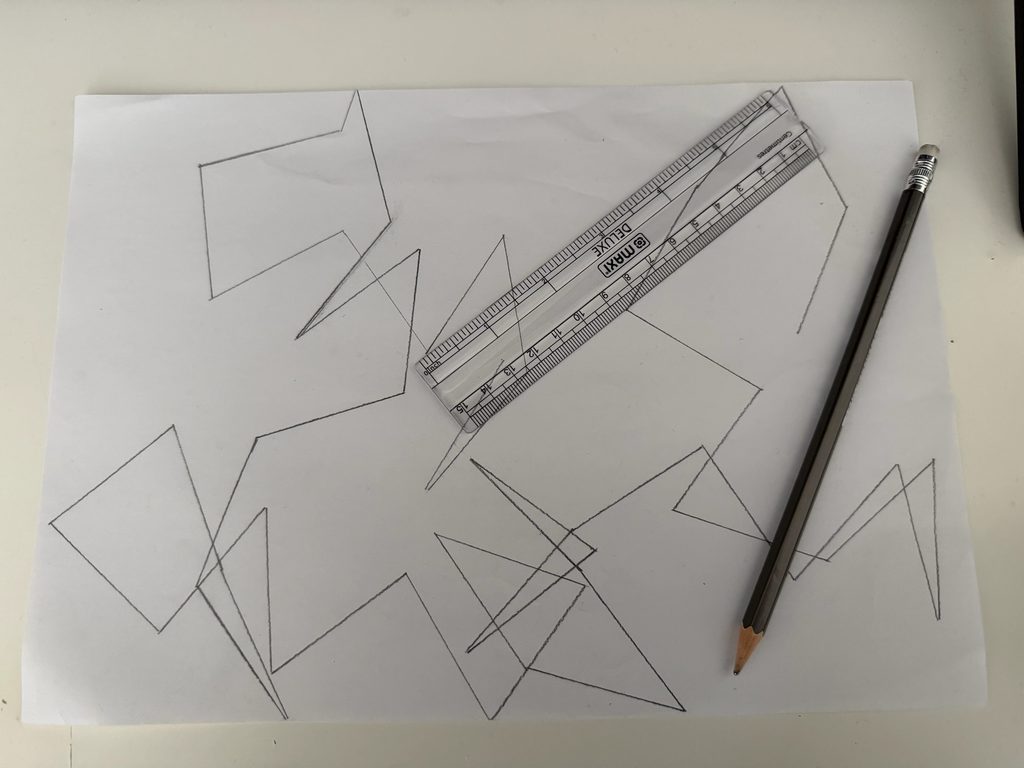
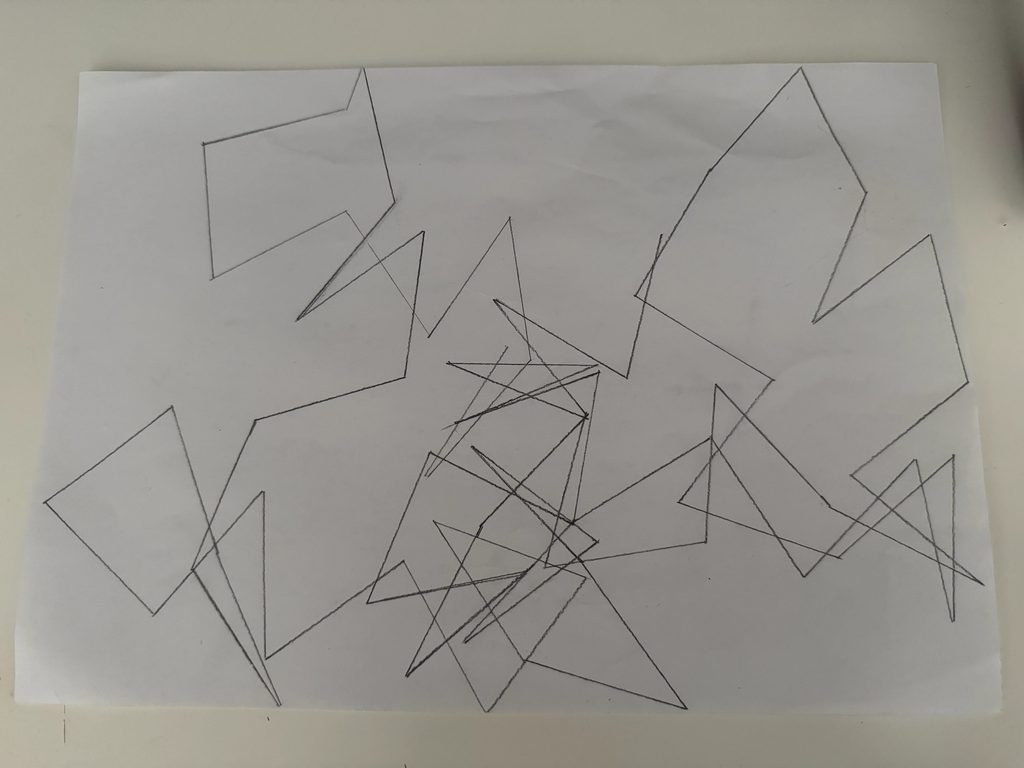
I repeated the same process to create multiple drawings using the same rules. Even though the pencil, rules, and process stayed the same, each drawing developed differently because the direction of every spin was unpredictable.

Challenges
I think one of the main challenges was trying not to interfere with the system. Sometimes the pencil would point toward a section that already had a lot of lines, and my instinct was to spin again or slightly change the direction. However, I realised that doing this would give control back to me, so I had to accept the direction the pencil landed in, even if I did not prefer the visual result.

Another challenge was to make sure that I was reading the direction of the pencil as accurately as possible. I realised that even with a system that is based on chance, it can still be difficult to totally remove human control because I was still the one spinning the pencil and translating its direction into a line.

Reflection: Control, Chance, and Authorship
Overall, I think this changed how I view how much control an artist needs to have over an artwork. I came up with the system and thought about all the rules before I started, which meant I still had an important role in creating the work. However, when I actually started, I gave up a certain amount of control over one of the most important decisions, the direction of each line. This means that chance really became an important part of the drawing process. I was not able to predict what the next spin would produce or even what the finished composition would look like. At the same time, the drawing was not completely random because it was still limited by the rules I had created. This then led me to reflect on the idea of authorship, and how I see myself more as the author of the “system” rather than the exact appearance of the final drawing. The pencil and chance influenced the result, but they were only able to do that because of the rules I created.

Connection to Sol LeWitt
My drawing system connects to Sol LeWitt’s idea that in conceptual art, the planning and decisions can be made before the artwork is actually produced. He describes this by saying that the idea can become the “machine” that makes the art. I think the idea of my drawing mainly resides in the design decisions and rules of the system, rather than in a specific finished drawing. Before I started, I already decided how the pencil would be spun, how I would respond to the direction it pointed, and how each line would be made. After I established those rules, I made as few subjective decisions as possible while creating the drawings. This is related to LeWitt’s discussion of working with a pre-set plan, where the artist chooses the basic rules and then allows the plan to determine the work.

However, my system is slightly different from LeWitt’s approach because chance is intentionally important in my project. While I knew the rules before, I did not know what the pencil would decide with each spin. Because of this, I would say the final drawing is evidence of the idea rather than the idea itself. If I gave the same instructions to another person, they could create a completely different drawing, but it would still be the same concept.

I also considered the process of an artwork to be as important as the final product. LeWitt points out that sketches, failed works, studies, conversations and other stages of a work can reveal the artist’s thought process and may even be more interesting than the final product. In my case, seeing the pencil being spun and really understanding the rules behind every line is crucial because without knowing the system, the final drawing may simply look like a collection of random lines.

Negative Space

Assignment 1

Concept
The main concept of my drawing machine is using negative space, different shapes, and different materials to create a drawing through chance. I wanted the system to have some parts that stay fixed, or controlled variables, and other parts that change each time. I start by randomly choosing a paint color. I do this by shaking a box of colors, counting to five, and choosing one without looking. I then mix that color with water in a spray bottle, using around the same amount of water and paint each time. After that, I take a cup filled with different materials, including small wooden sticks, pasta shapes, and buttons, and flip it over onto the middle of the paper. Wherever the materials fall, I leave them there without moving them. I then spray the paper ten times. When I remove the materials, the spaces they covered stay blank, creating the negative space. Because the color and placement of the materials are random, every drawing comes out differently even though I follow the same system.

Photos/video of the machine

Several drawing outputs

Process and challenges

One of the main challenges was making sure that the fixed parts of my system actually stayed fixed. Since I am the person spraying the paint, it would be easy for me to accidentally spray one piece more than another. To solve this, I decided that every drawing would receive exactly ten sprays. I also tried to use around the same amount of water and paint in the spray bottle each time. Another important rule was that once I flipped the cup and the materials fell onto the paper, I could not move or rearrange them. This helped me avoid changing the composition based on what I thought looked better and allowed chance to have more control over the final result.

Reflection on control, chance, and authorship


I think this project has a balance between control and chance. I have control over creating the system, choosing the materials, deciding the amount of paint and water, and setting the rule of ten sprays. However, I do not control which color gets chosen or where the materials land on the paper. Those parts are left to chance. I still see myself as the author of the work because I created the idea, rules, and system, but I am not directly designing every part of the final drawing. The final piece is a combination of my decisions and the random results created by the system.

In relation to Sol LeWitt’s Paragraphs on Conceptual Art, where does the “idea” of your drawing reside: in your design decisions, the machine,, or the final drawing? Explain briefly.


In relation to Sol LeWitt, I think the main idea of my drawing resides in my design decisions and in the system I created, rather than in the final drawing itself. I decided the rules and structure before making the pieces, and once the process starts, I follow those rules instead of changing the artwork based on how it looks. LeWitt explains that in conceptual art, the planning and decisions are made beforehand and that the idea can become “a machine that makes the art.” I think this connects to my project because my rules almost become the machine. I create the system, but chance carries out part of the execution. The final drawing is therefore one possible result of the idea rather than the idea itself. LeWitt also discusses how a pre set plan can reduce decisions made while creating the work, which is similar to why I made rules such as ten sprays and not moving the objects after they fall. 

Assignment #1 — Low-Tech Drawing Machine (or is this a system?)

Gravity Balls – Color Chaos

Concept

For this project, I wanted to make a drawing where I could control the idea but not really control what the final piece would look like. My idea was to take a handful of bouncy balls, dip them in different colors of paint, and drop them onto a large sheet of paper. Wherever the balls bounced and whatever marks they made would become the drawing.

I liked this idea because the setup is really simple, but the result is impossible to fully predict. Even if I repeated the exact same steps, I would never get exactly the same drawing twice.

Photos/video of the machine

For my “machine,” I used the bouncy balls, paint, gravity, and the movement created when the balls hit the floor. I basically start the process by dropping them, but after that I don’t control where they go.

Several drawing outputs

Each drawing came out differently even though I followed the same basic process and tried to drop them in the exact same way and position. Some had more concentrated marks while others were more spread out. I liked seeing how much the results could change without me purposely changing the composition.

Process and challenges

The process was pretty simple, but the hardest part was actually not interfering. Sometimes I wanted to move a ball toward an empty area or add more paint somewhere, but that would defeat the point of the project.

Another challenge was that the balls didn’t always behave how I expected. Some bounced really far, some barely bounced, and the amount of paint on each ball also changed the marks. After a few tries, I realized those unpredictable parts were actually what made the project interesting.

Reflection on control, chance, and authorship

This project made me think a lot about how much control an artist actually needs to have. I controlled the materials, colors, number of balls, and the way they were dropped, but I couldn’t control the exact marks.

Because of that, I don’t think the drawing is completely controlled by me or completely controlled by chance. It’s somewhere in between. I created the situation, but the bouncy balls and gravity decided what happened inside of it.

It also made me question authorship a little. I would still call myself the artist because I came up with the idea and created the rules, but I wasn’t directly making every mark on the paper.

In relation to Sol LeWitt’s Paragraphs on Conceptual Art, where does the “idea” of your drawing reside: in your design decisions, the machine, or the final drawing? Explain

After reading Sol LeWitt, I think the “idea” of my drawing mostly exists in my design decisions. LeWitt says that in conceptual art, the idea is the most important part and that the planning and decisions can happen before the work is actually made.

For my project, the important part isn’t one specific final drawing. It’s the decision to use painted bouncy balls and let their movement create the drawing without controlling them afterward. The machine is what carries out that idea, and the final drawing is basically evidence of what happened.

I think this became even clearer after making several drawings because they all looked different, but I still saw them as part of the same artwork. The thing connecting them wasn’t how they looked. It was the idea and the rules behind them. LeWitt says that a work begins with an idea and that the process of conception and realization is what the artist is concerned with.  That connects really well to what happened with my project.

Assignment #1 — Low-Tech Drawing Machine (or is this a system?)

a. Concept

At first, I wanted to use the strings of my backpack, attaching crayons to them in order to draw on sheets of paper placed on the floor. However, this felt too manual and did not fully achieve the effect I was looking for. After thinking about the materials I had available, I eventually arrived at the idea of creating a drawing machine that relies on speed and gravitational force to produce its drawings.

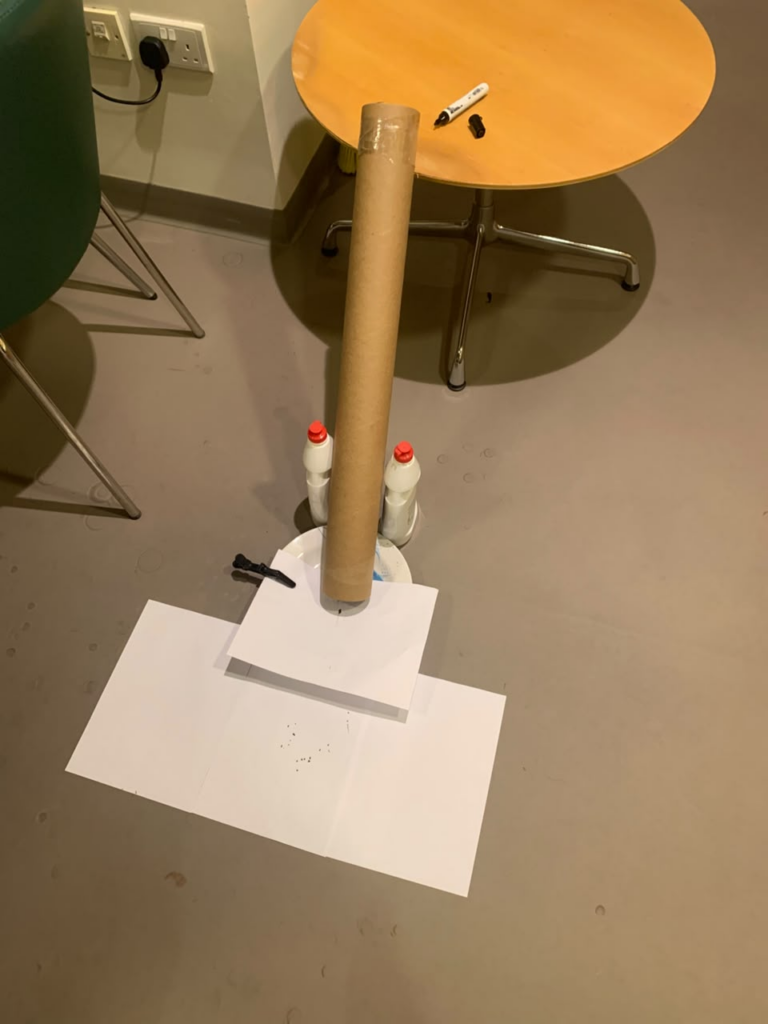
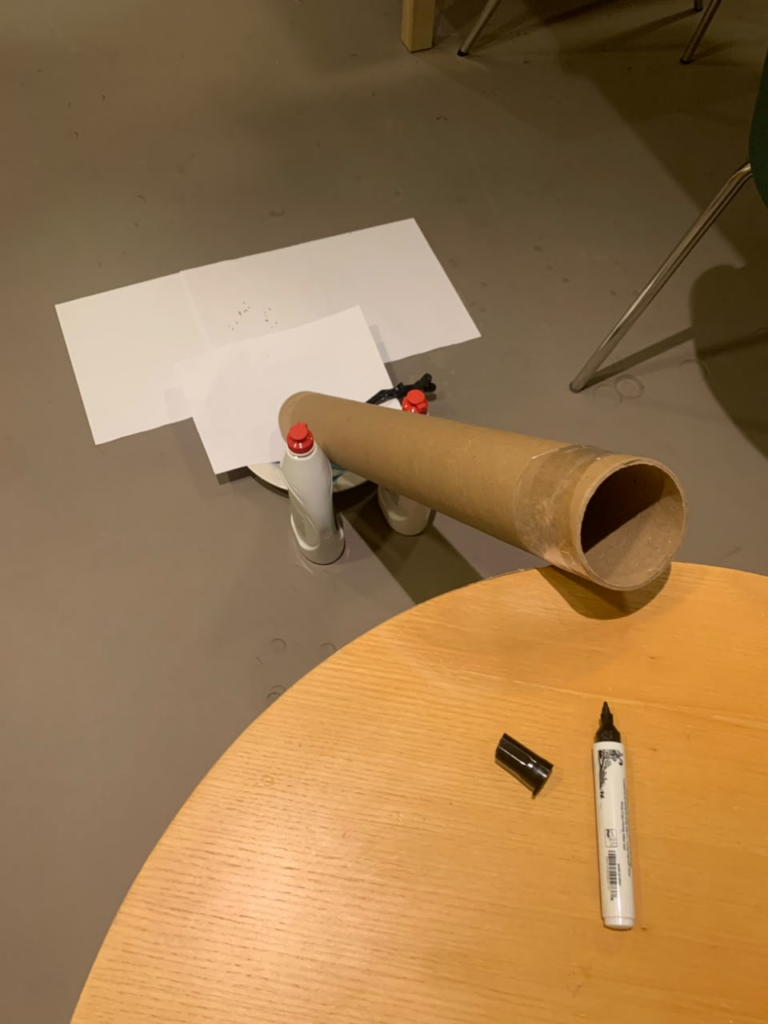
As you can see in the video, this is a very simple system consisting of one tube, a sheet of paper placed on top of a plate, which is held in place on one side by a clothespin, and additional sheets of paper surrounding part of the plate to prevent trails from being left on the surface. Two bottles filled with liquid, in this case, two bottles of Axion, are used to hold the tube in place. Finally, a marker is used to create the drawing trails.

The way it works is very simple. The user only has to take a marker of their choice and place it at the top opening of the tube, allowing it to fall and leave a trail on the paper. This process can be repeated for as long as the user likes, allowing them to create different drawings and patterns.

I admit that this can come across as a rather manual device. However, the lack of available objects that could automate the drawing process led me to rely on another kind of force instead: gravity. In the end, this simple system was able to produce some interesting results, as can be seen below.

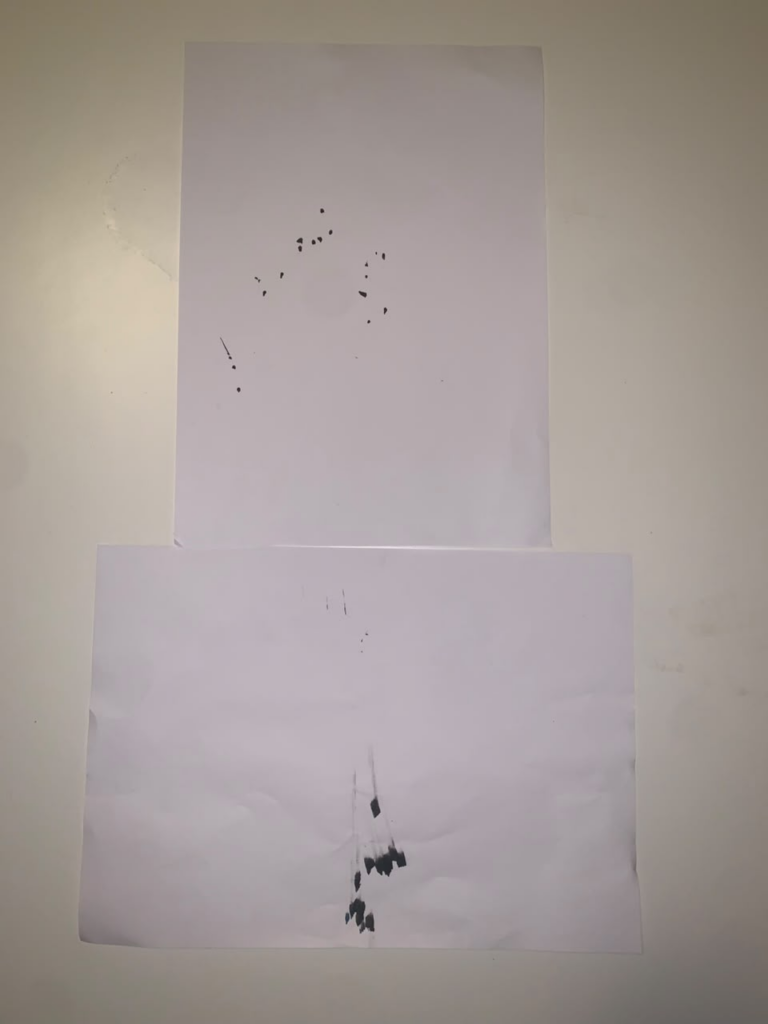
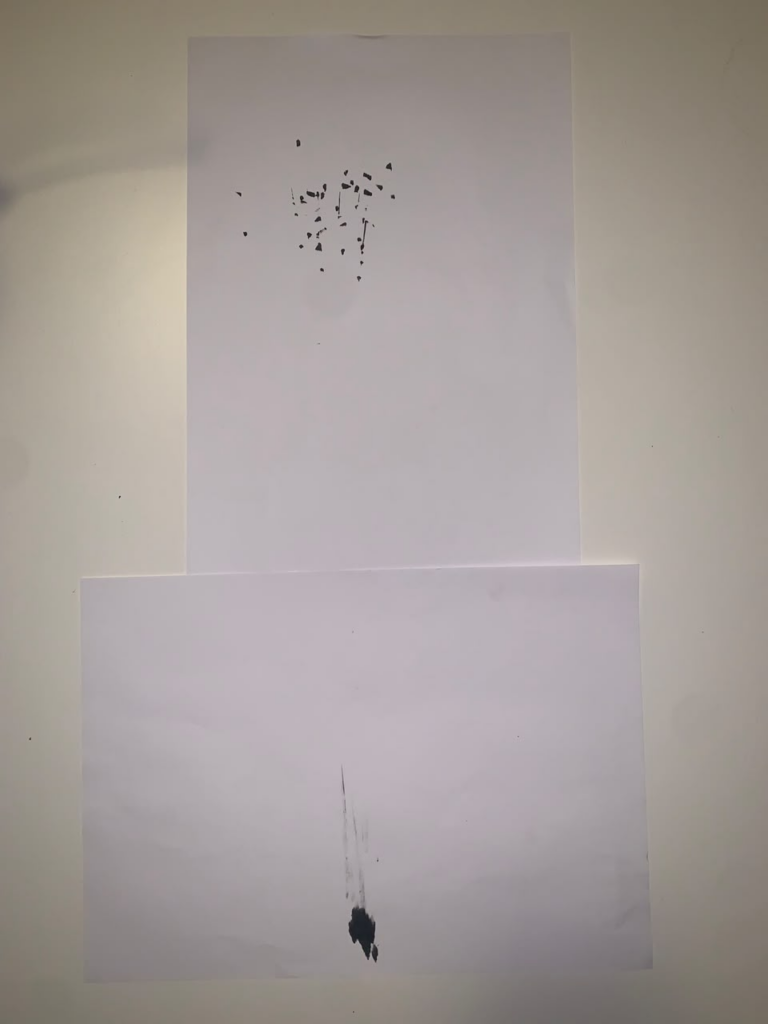
b. Drawing outputs

The result from the video.

After recording the video, I did another one.

Other results from the machine. These are rather difference due to the fact that I moved the location of the clothespin to the top of the plate, making the markers leave a trail to the sides due to the collision.

c. Process and challenges

The process of making this machine is quite simple. The main idea was to find the necessary materials and arrange them as shown in the video. However, conceptually, I found this to be the hardest step. I tried to come up with more interesting ideas, but unfortunately, this was the only plausible one I could think of that could be made with the materials I had available, as well as those of my roommate.

Another challenge that I am not sure I was able to overcome was the machine’s reliance on a human element to produce the drawings. While the person is mostly acting as an activation force rather than actively drawing on the machine, there was no other reasonable solution I could think of that would completely remove the need for human interaction. Although this aspect was not entirely satisfactory from my perspective, I still expect the machine to provide some enjoyment through its physicality and the way the user interacts with it.

d. Reflection on control, chance, and authorship

When it comes to control in art, I do not believe that it is inherently a bad thing. Rather, it is simply a different way of approaching the creative process and influencing what the final result can be. Something similar can be said about chance in art. However, I would not want a machine or system to randomly create something without any clear purpose or intention, as I feel that the result could become meaningless.

When I mention something being “meaningless,” I am referring to the possibility of creating something with absolutely no idea or intention behind it. However, I believe this is not really possible. For example, if someone were to build a machine with the intention of having no purpose, then, in a strange way, the purpose of that machine would be to demonstrate that it has no purpose. It is a somewhat strange idea, but when looking at it more literally, I believe that authorship is not necessarily affected by either the level of control over the parameters of an artwork or the presence of chance and randomness.

This is because artworks generated through parameters are still, inherently, the result of human ideas. The person creating the system is envisioning some kind of final product, even if the final result may differ from what they originally had in mind. The parameters, materials, rules, and limitations are all decisions made by the artist, and these decisions shape the possibilities of what the system can produce.

For example, the system I created for this assignment was constructed through a series of improvised ideas using materials that I happened to encounter, some of them almost entirely by chance. Even though the final drawings are technically “made” by the machine, the results still reflect the decisions and ideas that I had throughout the process. I chose the materials, constructed the system, determined how it would work, and decided how the user would interact with it. The machine may have created the individual drawings for me, but the conditions that allowed those drawings to exist were created by me.

e. Where does the “idea” of your drawing reside?

For me, the idea resides in the design decisions rather than in the machine itself or the final drawing. There was certainly some deliberation involved in deciding to create something physical that is capable of creating drawings. However, the main purpose behind creating it was not simply to prove the existence of the machine. Rather, a demonstration of an idea: a way to produce art through the use of gravity, using whatever means were available to me.

To reiterate, I believe that the idea resides in the design decisions behind the system. These decisions included the idea of creating something that uses a different kind of medium to produce art, as well as determining the materials, structure, and way in which the machine would operate. The final drawing is simply the visible result of those decisions and of an idea that already existed in my mind. And although the machine is responsible for physically producing the drawing, it is still operating within a system that I conceptually imagined, idealized, and designed. It just happens that the idea of the drawing could, in theory, be observed in maximum detail when the design decisions are examined; similar to understanding what is happening inside the “black box.”